

Bioscience
The hidden coordination behind DNA copying
A KAUST study reveals how the molecular machinery that copies human DNA keeps its many parts working in step before cells divide.


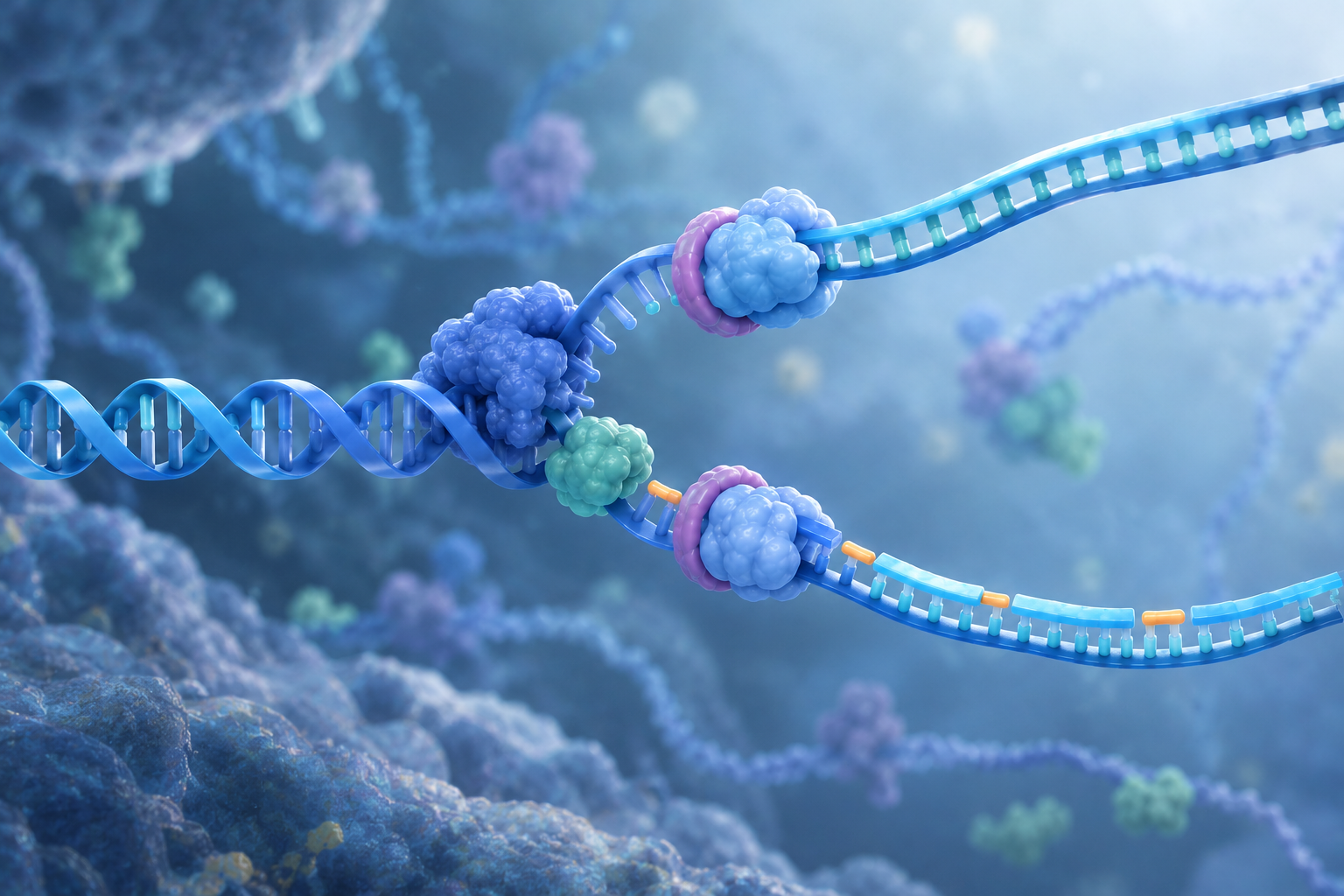
- Accurate DNA replication ensures that cells pass on the correct genetic instructions when they divide.
- Copying the two DNA strands involves different processes that must be coordinated.
- By rebuilding the complete human DNA replication machinery, KAUST researchers revealed how the process is coordinated and established a system to investigate how errors in DNA copying contribute to disease.
How do cells copy their DNA?
Before a cell divides, it must copy its DNA so that both new cells receive the genetic instructions they need. DNA replication is essential for organisms to grow, maintain tissues and reproduce. It involves a series of carefully coordinated steps carried out by a molecular machine called the replisome, in which nearly 50 proteins work together to separate DNA’s two strands and build a new copy of each.
But the strands are copied in different ways, says KAUST alumna Amani Al-Amodi, the lead author of the study. “One, called the leading strand, is made continuously. The other, called the lagging strand, is built in short pieces known as Okazaki fragments. These pieces must then be processed and joined to form a continuous strand,” she explains.
How are the two DNA strands copied in sync?
Published in Nature Communications, the study addresses a fundamental question in genome biology: how does the replisome keep the synthesis of both DNA strands on track when the processes involved run at different speeds?
To answer this question, KAUST researchers became the first to reconstitute a complete human replisome from purified proteins, reproducing the synthesis of both the leading and lagging DNA strands together with their maturation in a controlled laboratory setting[1]. This system allowed them to study how the different components work together.
“We found that the replisome briefly slows copying on the leading strand when a new fragment is started on the lagging strand,” says Muhammad Tehseen, a research scientist at KAUST who co-led the study. “This helps coordinate the two activities. The enzyme that extends the lagging-strand fragments is also efficiently reused, helping keep new fragment production going.”
Together, these mechanisms allow both strands to be copied at similar overall rates, even when some fragments are still waiting to be joined. Processing and joining take place behind the advancing replication machinery, and this continues after copying has ended.
How could this help us understand disease?
Defects in DNA replication are associated with disease. The rebuilt human system gives researchers a way to study how mutations affecting individual replication proteins alter the DNA-copying process.
“We now plan to use this system to investigate mutations associated with inherited disorders caused by changes in a single gene in Saudi Arabia,” says Samir M. Hamdan, KAUST professor of bioscience and corresponding author of the study. “This could help explain how these mutations disrupt DNA copying and contribute to disease.”
The system also provides a foundation for studying how DNA replication works alongside other processes inside cells, how errors in these mechanisms can contribute to disease, and how this knowledge could help guide the development of treatments.
Reference
- Al-Amodi, A., Tehseen, M., Raducanu, V.S., Takahashi, M., Ouyang, Y., Danazumi, A.U., De Biasio, A., Hamdan S.M. Reconstituting human and SV40 replisomes with Okazaki fragment maturation reveals synchronized leading- and lagging-strand synthesis. Nat Commun 17, 10862 (2026).| article
You might also like
Applied Physics
Colorful solution to advanced disease diagnosis
Bioscience
Multi-enzyme pathway delivered into living cells
Bioscience
Brain fuel also helps wire neural connections
Bioscience
Single small-molecule model reveals insights into human embryo development
Bioscience
Can AI finally bring order to biology’s data deluge?
Bioengineering
Bio-inspired network structures for next-generation AI
Bioscience
Robust workflow built for chemical genomic screening
Bioscience