

Bioscience
Brain fuel also helps wire neural connections
Lactate acts as both fuel and a signaling molecule in the brain, revealing a potential pathway for treating neurological disease.


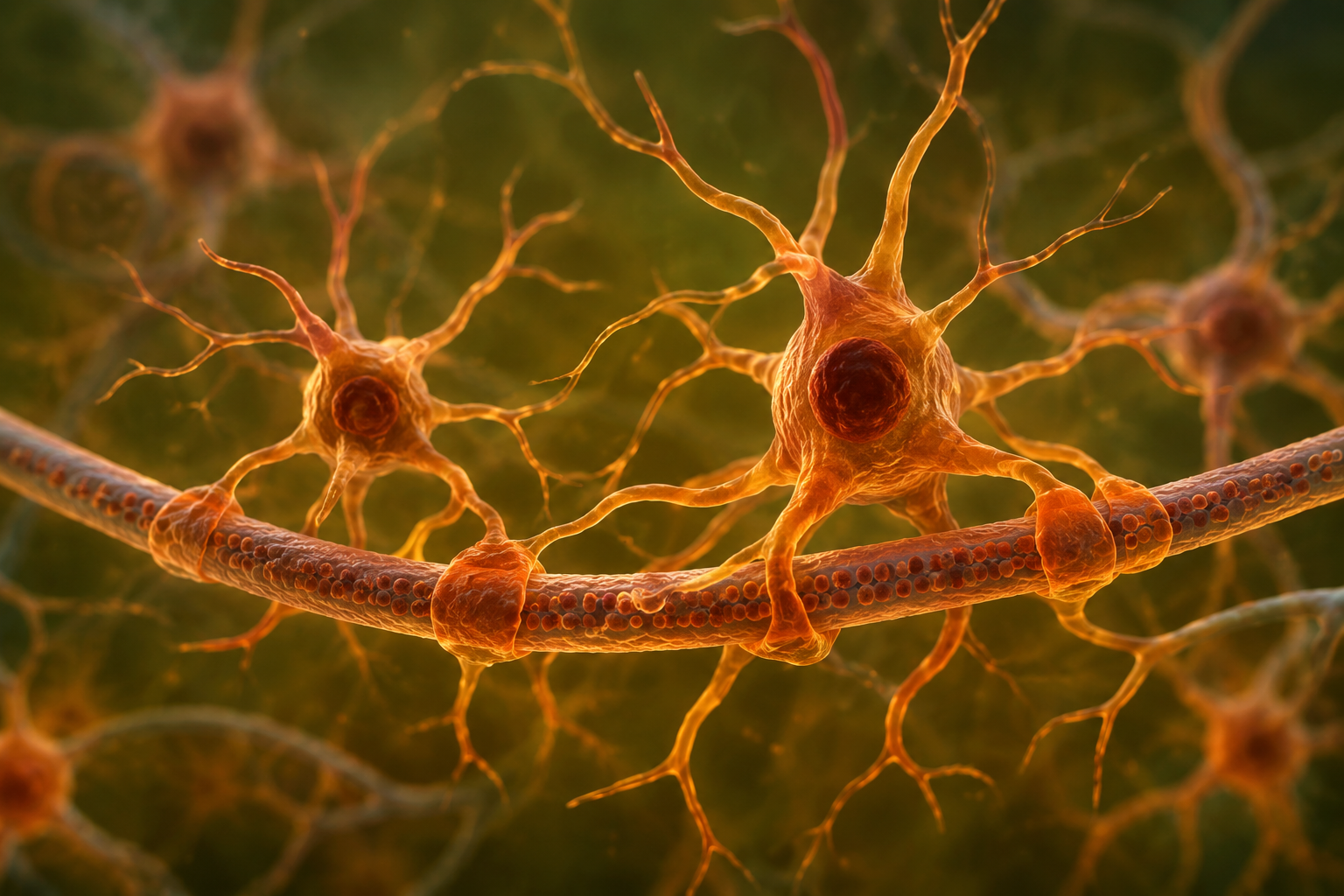
The human brain has an estimated 86 billion neurons, and an even greater number of support cells, called glia, long thought to provide mainly structural support and nourishment while neurons do the real cognitive work.
A KAUST-led study now reveals that this division of labor is not so clean.
As Pierre Magistretti and his colleagues demonstrate, one type of glial support cells in particular — astrocytes, star-shaped glial cells — do more than keep neurons fed[1]. They actively shuttle a molecule called lactate into neurons, where it triggers a chain of events that strengthens synaptic connections involved in core brain functions.
“This observation represents a paradigm shift,” says Magistretti, neuroscientist at KAUST. “It shows that glial metabolism is an integral part of information processing by neurons, with implications for learning and memory.”
At the heart of the finding is a set of proteins called NMDA receptors. These sit at synapses, the junctions where neurons communicate, and govern how strongly signals pass between cells. They are activated by neurotransmitters released by neurons.
But neurotransmitters are not the whole story. The KAUST study shows that astrocyte-derived lactate also acts on NMDA receptors, amplifying their activity and, with it, the strength of synaptic signals.
Lactate is best known for building up in fatigued muscles, but it has a second life in the brain. Astrocytes produce it continuously and ship it to neurons as fuel, a metabolic arrangement that Magistretti’s laboratory first described more than 30 years ago, naming it the ‘astrocyte-neuron lactate shuttle’.
However, lactate’s role does not end at the fuel pump. The new study shows that once inside a neuron, it also acts as a signal — one that alters the cell’s internal chemistry, amplifies NMDA receptor activity and locks in stronger synaptic connections.
This occurs through a finely tuned molecular cascade. Working with collaborators in Europe, the KAUST team found that neurons convert incoming lactate into pyruvate, a reaction that generates NADH and tips the cell’s chemical balance in a way that boosts calcium signaling. That shift tightens the grip of a key enzyme on NMDA receptors, driving a burst of synaptic activity that yields lasting changes in connection strength, cementing memories and deepening learning.
“Our study uncovers a previously unknown molecular mechanism by which lactate regulates brain function,” says Hubert Fiumelli, a research scientist in Magistretti’s lab and co-author of the study. “We show that lactate acts not only as a source of energy, but also as a signaling molecule that directly strengthens communication at synapses.”
The findings further disrupt a century of neuroscientific orthodoxy that cast glial cells as little more than “brain glue” filling gaps between neurons and lactate as a metabolic waste product. But they also point somewhere more practical.
Scientists have long suspected that NMDA receptors hold the key to treating Alzheimer’s disease, schizophrenia, and major depression — conditions in which there is a breakdown in the brain’s ability to form and maintain connections. What has been missing is a clear molecular picture of how those receptors are regulated. The lactate pathway now provides one.
“These findings open new avenues for therapeutic strategies targeting brain metabolism,” Fiumelli says.
Reference
- Fiumelli, H., Herrera-López, G., Lemtiri-Chlieh, F., Mottier, L., Girgis, J., Ben-Adiba, C., Jourdain, P., Carrano, N., Mahmood, H., Ooi, A., Arold, S.T., Di Luca, M., Gardoni, F. & Magistretti, P.J. Lactate potentiates NMDA receptor currents via an intracellular redox mechanism targeting GluN2B subunits: implications for synaptic plasticity. The Journal of Physiology, 604, 3934-3963 (2026).| article.
ABOUT THE AUTHOR
Hubert Fiumelli
Research scientist

You might also like
Applied Physics
Colorful solution to advanced disease diagnosis
Bioscience
Multi-enzyme pathway delivered into living cells
Bioscience
Single small-molecule model reveals insights into human embryo development
Bioscience
Can AI finally bring order to biology’s data deluge?
Bioengineering
Bio-inspired network structures for next-generation AI
Bioscience
Robust workflow built for chemical genomic screening
Bioscience
Cell atlas offers clues to how childhood leukemia takes hold
Bioscience