

Chemistry
Opening a window on architectural nano-design
Ancient building technique inspires a potential solution to the modern challenges of gas separation and storage.


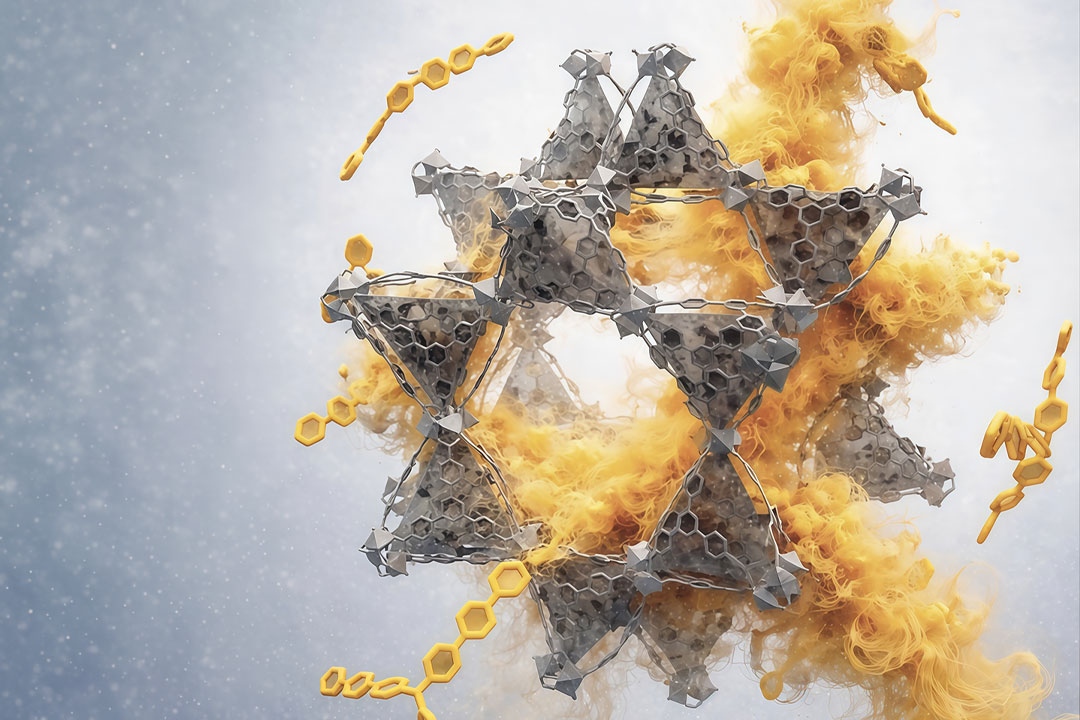
Master stonemasons use temporary timber formwork to help them build grand stone window frames, domes, and archways. Master molecule makers have now adapted this technique to the nanoscale, creating crystalline materials with airy molecular architectures featuring vast internal spaces and wide, open windows.
Like the best buildings, the resulting materials combine elegant architecture with practical function. With their record-breaking internal volume, these porous materials could find applications for storing target gases such as carbon dioxide and methane.
Mohamed Eddaoudi and his team at KAUST, including research scientist Vincent Guillerm, are pioneers in ‘reticular chemistry’. They design molecular building blocks that link to form open three-dimensional structures such as metal-organic frameworks (MOFs), which consist of metal atoms connected by organic linkers.
The team recently developed a way to make MOFs of exceptional structural complexity, by using molecular scaffolds called centring structure directing agents (cSDA) that template the MOFs’ assembly into the desired structure[1].
“These cSDAs enabled us to make novel architectures, or topologies, that were unattainable through conventional synthetic approaches,” Guillerm says.
In the team’s first examples, the cSDAs were a permanent feature of the MOF structure. If the cSDAs could be removed, however, it would free up volume and improve the flow of gas molecules in and out of the structure. “The key motivation for our latest work was to transform cSDAs from permanent structure-directing ligands into temporary molecular scaffolds,” says Aleksandr Sapianik, a postdoc in Eddaoudi’s lab.
Finding a way to selectively remove the cSDAs without damaging the rest of the structure was the key challenge[2], Guillerm says. “We developed two complementary routes based on the intrinsic stability of the parent MOFs,” he adds. Both routes target the metal-nitrogen bonds that hold the cSDAs in place, which are relatively weak compared to the metal-oxygen bonds holding the MOF’s core skeleton structure together.
Chromium- and iron-based MOFs were chemically stable enough for the team to selectively remove the cSDA scaffolding using an acid wash. For MOFs with more modest stability, such as those based on indium, the team developed a milder method based on treating the material with a reagent called imidazole.
Removing the cSDA scaffolding transformed the materials’ properties and performance. “The porosity of the material was increased by up to 50% in the best cases, to the highest pore volumes ever reported for iron-, indium- and chromium-based MOFs,” explains Marina Barsukova, a postdoc in Eddaoudi’s lab. The team tested a MOF called Fe-sod-ZMOF-300 for its methane storage capacity, and showed it could reversibly store approximately 20 percent more of the gas once the cSDA was removed.
“Once the framework becomes structurally encoded and self-supported, removal of the cSDA unlocks the true functionality of the material, such as accessible pore space, enhanced adsorption properties, and new opportunities for selective transport,” Eddaoudi says.
To date, MOFs have been mostly static structures. The next step, Eddaoudi explains, is to develop MOFs that can dynamically change their structure and function in a controlled manner over time. “We envision porous materials in which transient structure directing agents not only enable unprecedented topologies and pore architectures, but orchestrate emergent functionalities including selective separations, catalysis and conductivity,” he concludes.
Reference
- Barsukova, M., Sapianik, A., Guillerm, V., Shkurenko, A., Shaikh, A.C., Parvatkar, P., Bhatt, P.M., Bonneau, M., Alhaji, A., Shekhah, O., Balestra, S.R.G. , Semino, R., Maurin, G., Eddaoudi, M., Nature Synthesis 3, 33-46 (2024).
- Sapianik, A., Barsukova , M., Shkurenko , A., Bonneau, M., Bhatt, P. M., Shekhah, O., Guillerm, V., Eddaoudi, M. Single-crystal to single-crystal editing of metal–organic frameworks via ligand removal. Nature Chemistry 18, 994–1003 (2026). | article.
You might also like
Bioscience
Multi-enzyme pathway delivered into living cells

Chemical Engineering
Natural solvents enable fully bio-based membranes

Chemistry
Turning infrared solar photons into hydrogen fuel
Applied Physics
Natural polymer boosts solar cells
Chemistry
Disruptive smart materials flex with real world potential
Chemistry
Catalysts provide the right pathway to green energy
Chemistry
Hollow molecules offer sustainable hydrocarbon separation
Chemistry