

Applied Physics | Chemistry | Material Science and Engineering
Natural polymer boosts solar cells
A thin layer of heparin sodium enhances the performance of perovskite solar cells.


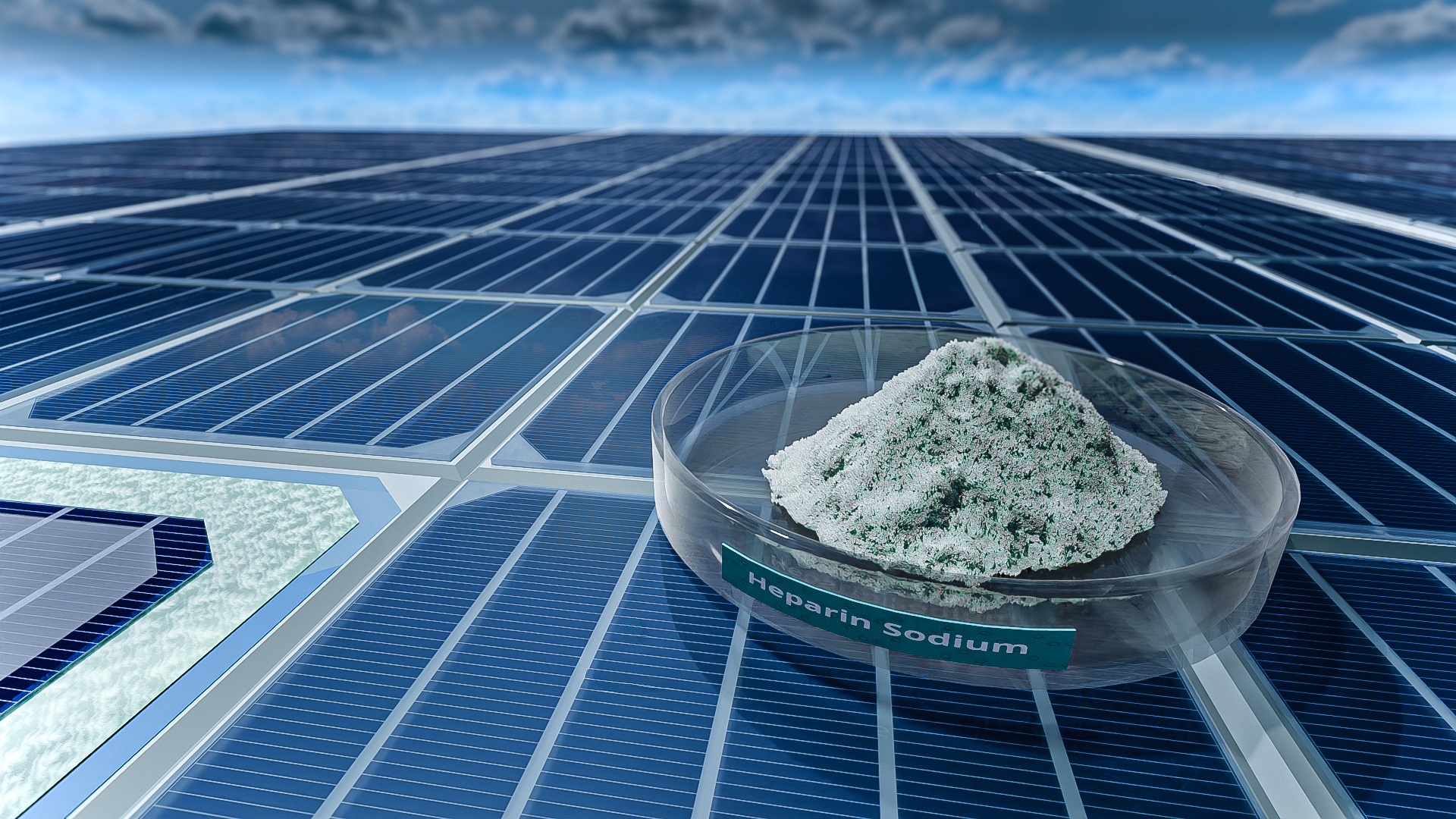
A naturally occurring polymer commonly used as a medical anticoagulant can improve the stability, flexibility and efficiency of next-generation perovskite solar cells, KAUST researchers have discovered[1]. The polymer acts as a molecular bridge between two crucial layers within the solar cell, easing the flow of electrical charge and helping to make the devices more robust.
Perovskites are a family of light-harvesting semiconductors based on abundant, inexpensive materials such as lead and iodine. While most commercial solar cells rely on relatively thick slabs of crystalline silicon, perovskite solar cells have a much thinner light-absorbing layer, enabling lightweight and flexible devices. The efficiency of perovskite solar cells has soared over the past 15 years, with the best cells converting 27 percent of the light that falls on them into electricity, similar to the most efficient silicon cells.
However, perovskite cells also tend to degrade much more rapidly than silicon cells, partly due to problems at the interfaces between layers inside the perovskite cells, which can reduce efficiency and make the cells more fragile.
When light hits a solar cell, it frees electrons in the absorbing layer, which move into an adjacent electron transport layer, made of materials such as tin oxide, and onwards to an electrode. Weak binding between these layers can reduce the mechanical strength of the device, while defects at interfaces can trigger perovskite decomposition and significantly reduce the cell’s efficiency.
Other researchers have previously used small molecules to address these interface problems. “But small molecules usually cannot provide the structural integrity and high mechanical stability and flexibility that polymers like heparin sodium can offer,” explains Omar F. Mohammed, who led the research at KAUST.
Doctors use heparin sodium to prevent blood clots from forming in patients, but this sugar-based polymer has value in other contexts as well. One advantage is that it bristles with negatively charged chemical groups — carboxylates and sulfonates — alongside positively charged sodium ions.
The researchers inserted a thin film of heparin sodium, just 3–5 nanometers thick, between the perovskite and tin oxide layers in a solar cell. Tests showed that heparin’s carboxylate and sulfonate groups effectively passivated interfacial defects by compensating for missing iodine atoms, while its sodium did the same for missing lead.
Heparin’s chemical groups also formed robust bonds with lead and tin, binding the two layers together. “Its role as a molecular bridge is critical for both stability and flexibility in practical applications,” says Yafeng Xu, part of the KAUST team.
A perovskite solar cell containing heparin sodium boasted an impressive power-conversion efficiency of 26.61 percent, whereas an equivalent that lacked heparin could only manage 25.23 percent. The heparin device could be flexed 1,000 times without losing much efficiency. It was also more stable, retaining about 95 percent of its original output after 1,800 hours of operation, even when exposed to a temperature of 85°C. In contrast, the device without heparin lost roughly 30 percent of its efficiency under the same conditions.
The researchers now hope to apply these insights to improve the performance of larger perovskite solar cells.
Reference
- Tang, X., Yang, C., Xu, Y., Xia, J., Li, B., Li, M., Zhou, Y., Jiang, L., Liu, H., Ma, K., Yu, Q., Dong, B., Liu, Y., Mohammed, O. F. & Zheng, X. Enhancing the efficiency and stability of perovskite solar cells via a polymer heterointerface bridge. Nature Photonics 19, 701–708 (2025).| article
ABOUT THE AUTHOR
Yafeng Xu
Postdoc

You might also like

Applied Physics
Colorful solution to advanced disease diagnosis

Chemistry
Opening a window on architectural nano-design
Bioscience
Multi-enzyme pathway delivered into living cells

Chemical Engineering
Natural solvents enable fully bio-based membranes
Chemistry
Turning infrared solar photons into hydrogen fuel

Applied Physics
A single additive enables long-life, high-voltage sodium batteries

Bioengineering
Smart patch detects allergies before symptoms strike

Applied Physics