

Applied Physics | Material Science and Engineering
Interface engineering unlocks efficient, stable solar cells
An interface-focused strategy boosts efficiency and stability in perovskite/silicon tandem solar cells.


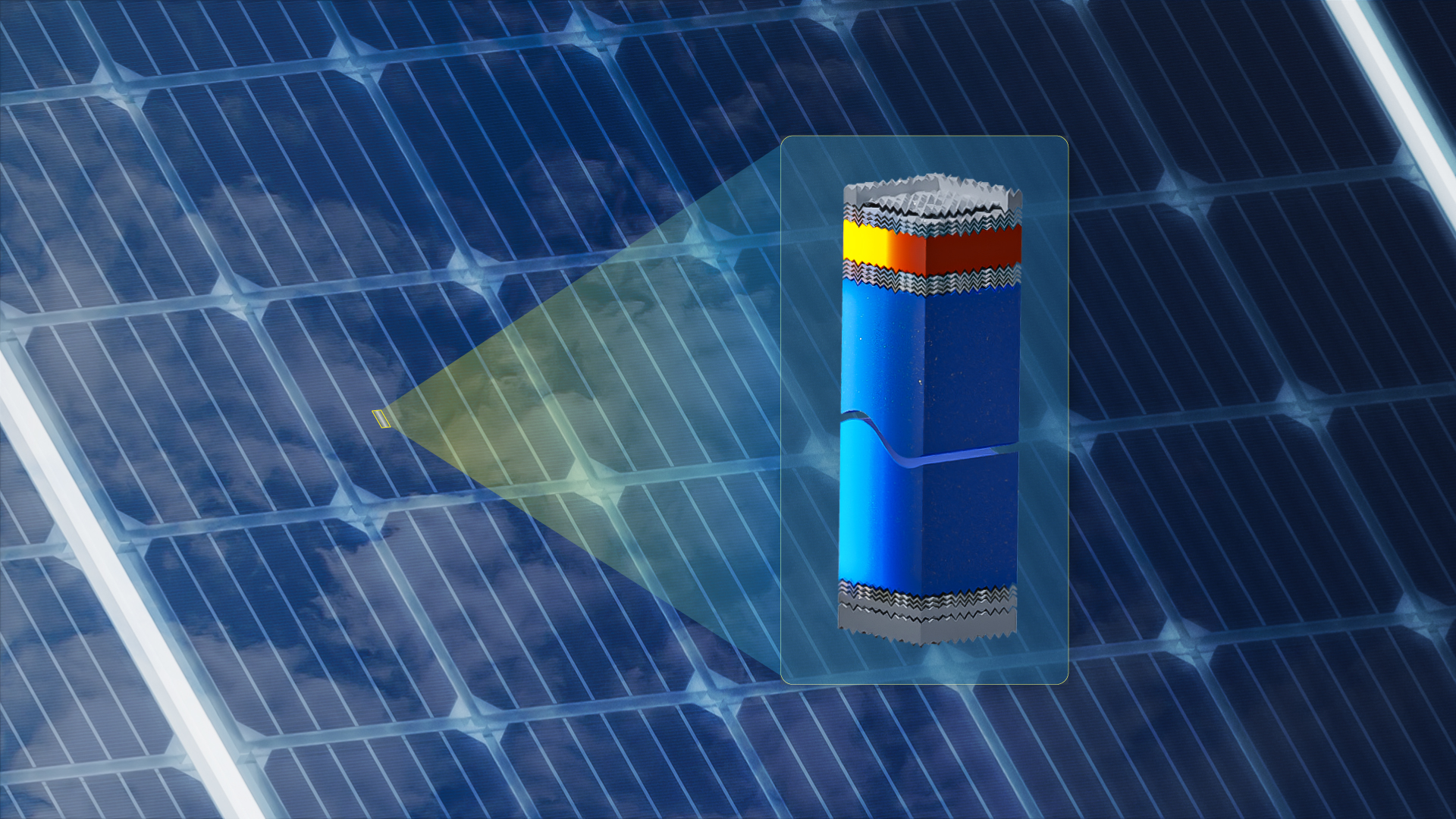
Improving the interfaces within perovskite/silicon tandem solar cells is a strategy that can boost solar performance and enhance stability. These key steps are important for bringing the advanced solar technologies closer to commercial viability and have now been developed by an international team of researchers from the Fraunhofer Institute in Germany and KAUST[1].
Silicon dominates the solar cell industry because of its stability and reliability. Perovskites are a cheaper and more accessible alternative for processing, exhibiting exceptional light-absorbing and electronic properties that have led to the development of high-efficiency devices. Their composition can also be tuned to enable light absorption in the green-to-blue wavelength range, a portion of sunlight that cannot be absorbed by silicon.
Combining these complementary materials in stacked, multilayered devices — known as tandem solar cells — can achieve the best of both worlds. Tandem solar cells that comprise an ultrathin perovskite film on top of a traditional silicon solar cell are expected to better harvest and convert sunlight into electricity than their subcells alone. Also, they are more cost-effective because they exploit industrially mature silicon technology.
Recent advances, such as maximizing light absorption and perovskite bulk crystallization, have pushed the power conversion efficiency of tandem solar cells over 29.4% — the theoretical maximum for silicon devices. Yet, interface-related challenges still limit cell performance.
When sunlight strikes the perovskite film, it creates pairs of electrons and positively charged holes. If there are any defects, these pairs tend to recombine at the interface between the perovskite and the electron-transport layer — which usually consists of the electron-acceptor C60 — before generating electricity.
This process of interfacial recombination reduces the maximum operating voltage, or open-circuit voltage, and the electrical performance of the tandem cells. A conduction band offset between the perovskite and C60 further depletes electrons at the interface, thereby enhancing recombination.
Several methods can help to address these interfacial problems, but these are ineffective for tandem cells using industry-standard textured silicon bottom cells with large pyramids on their surface.
Now, a team led by Stefan Glunz at the Fraunhofer Institute and Stefaan De Wolf at KAUST has developed a passivation approach that aims to reduce or eliminate defects, compatible with these fully textured silicon substrates. The approach is based on work-function engineering and uses 1,3-diaminopropane dihydroiodide as an interlayer material at the perovskite/C60 interface of the tandem cell.
The researchers produced an organic-rich perovskite film that conforms to the textured substrate by a two-step evaporation/spin-coating method. They treated it with the interlayer material before completing the tandem cell.
The interlayer material consists of two ammonium iodide functional groups bridged by a flexible hydrocarbon linker. Its structure enables it to bind asymmetrically to the perovskite surface. This generates a strong positive dipole moment that preferentially interacts with the organic-rich surface, increasing the work function —the minimum energy required for electron extraction.
Beyond conventional passivation, the interlayer material modulates the surface electrostatics by shifting the work function. The shift decreases the conduction band offset, allowing electrons to accumulate at the interface. “This suppresses interfacial recombination and improves electron transport across the entire perovskite film,” De Wolf explains.
“The passivated solar cells exhibit excellent open-circuit voltages and efficiencies, reaching 33.1%, which outperforms reference devices. They are also stable under prolonged exposure to high-temperature, high-humidity conditions. This demonstrates that interfacial work-function engineering can raise voltages and reduce charge transport losses without sacrificing stability,” De Wolf says.
In a separate study, the KAUST team has taken on challenges in triple-junction tandem solar cells[2]. These devices contain an additional perovskite layer, which results in a higher theoretical efficiency maximum, but also introduces more issues due to the phase instability of the perovskites.
KAUST researchers led by De Wolf have developed a method that enhances the stability and efficiency of solar cells by incorporating ammonium propionic acid iodide into the lattices of the perovskite layers. The additive comprises a carboxylic acid group that strongly binds to lattice cations, hindering phase transitions. It also improves the interface between the perovskite layers and self-assembled monolayers.
The method provides high-efficiency, high-yield, and stable triple-junction solar cells. The devices achieve a record efficiency of 28.7%, marking a meaningful progress for multi-junction solar technologies.
The team is currently engineering the hole-transport layer, ameliorating bulk film quality, and scaling up their devices to photovoltaic modules.
Reference
- Er-raji, O., Messmer, C., Pradhan, R. R., Fischer, O., Hnapovskyi, V., Kosar, S., Marengo, M., List, M., Faisst, J., Jurado, J. P., Matiash, O., Pasanen, H., Prasetio, A., Vishal, B., Zhumagali, S., Pininti, A. R., Gupta, Y., Baretzky, C., Ugur, E., Petoukhoff, C. E., Bivour, M., Aydin, E., Azmi, R., Schön, J., Schindler, F., Schubert, M. C., Schwingenschlögl, U., Laquai, F., Said, A. A., Borchert, J., Schulze, P. S. C., De Wolf, S. & Glunz, S. W. Electron accumulation across the perovskite layer enhances tandem solar cells with textured silicon. Science, eadx1745 (2025).| article.
- Xu, F., Aydin, E., Yavuz, I., Deger, C., Ugur, E., Liu, J., Zhang, X., Razzaq, A., Xu, L., Marengo, M., Vishal, B., Prasetio, A., Subbiah, A., Pininti, A., Allen, T. & De Wolf, S. Stabilized perovskite phases enabling efficient perovskite/perovskite/silicon triple-junction solar cells. Nature Materials (2025).| article.
ABOUT THE AUTHOR
Stefaan De Wolf
Professor

You might also like
Applied Physics
Colorful solution to advanced disease diagnosis
Chemistry
Turning infrared solar photons into hydrogen fuel

Applied Physics
A single additive enables long-life, high-voltage sodium batteries

Bioengineering
Smart patch detects allergies before symptoms strike

Applied Physics
Two-dimensional altermagnets could power waste heat recovery
Applied Physics
The right salt supercharges battery lifespan

Applied Physics
Light-powered ‘smart vision’ memories take a leap forward
Applied Physics