

Chemistry | Material Science and Engineering
Turning infrared solar photons into hydrogen fuel
Infrared-absorbing photocatalysts capture heat from sunlight to drive efficient hydrogen production.


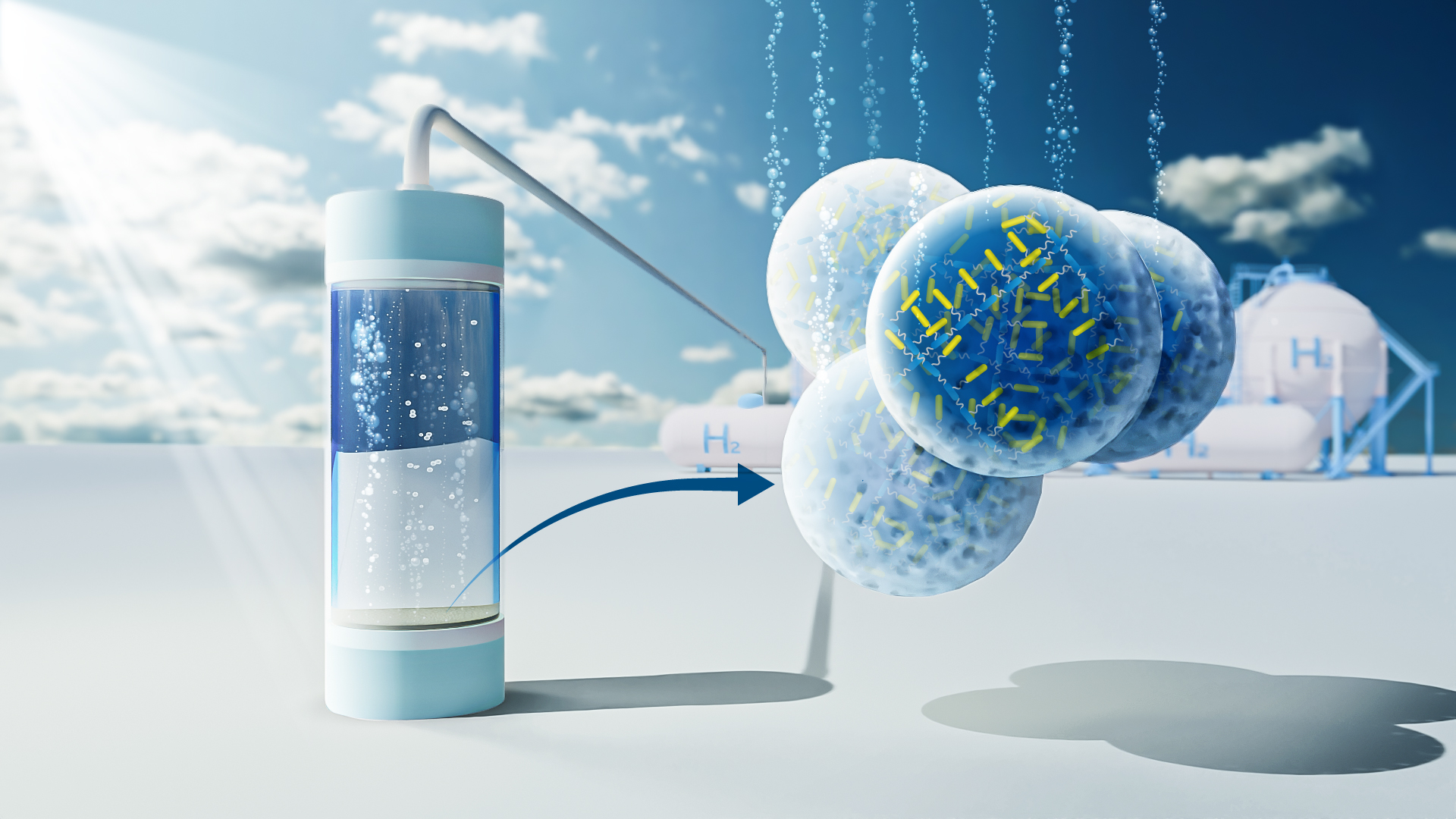
Stand in direct sunlight and you can feel it: the Sun delivers its biggest kick not as visible light, but as the infrared energy we experience as heat. Capturing this rarely tapped form of solar power could offer an efficient way to generate renewable fuels, KAUST researchers have shown[1].
“Saudi Arabia has some of the richest solar energy resources on Earth,” says Yunzhi Wang, a Ph.D. student in the lab of Huabin Zhang, who co-led the research. By harnessing this energy to split water molecules and release hydrogen, Saudi’s solar riches could be converted into an exportable resource. “Hydrogen is a versatile clean fuel, considered one of the most promising renewable energy sources,” Wang adds.
Although a range of known photocatalyst materials can harness the energy in sunlight to split hydrogen from water, most of these materials only absorb ultraviolet light, which makes up less than 5% of the solar spectrum. More recently, an unconventional type of photocatalyst made of organic molecules has been developed, which can capture the infrared light that makes up more than 50% of the Sun’s power.
To achieve efficient water splitting with these materials, however, researchers have had to use blends of two organic photocatalysts. Sunlight striking these materials generates pairs of excited-state electrons and positively charged holes. If the electron-hole pair immediately recombines, the captured solar energy is lost.
To counter this recombination, KAUST researchers mixed electron donor and electron acceptor photocatalysts, creating blends that quickly draw the excited electron and hole apart and enable hydrogen production.
“Producing these organic photocatalyst blends for real-world applications poses significant challenges,” Zhang says. It can be difficult to get the two components to mix, requiring complex fabrication processes. The resulting materials can also be unstable. “Single-component organic photocatalysts would therefore be more suitable for large-scale applications,” Zhang adds.
In a significant step toward that goal, the team has now designed an organic photocatalyst that does not need blending with another material to achieve efficient hydrogen production. “The photocatalyst is a type of long-chain organic material called a double-cable polymer,” Wang says.
“Double-cable polymers contain electron donor units as the conjugated polymer backbone and electron acceptors as side units,” Wang explains. The team showed that combining donor and acceptor groups in the same molecule successfully supported rapid electron-hole dissociation, enabling efficient solar-powered hydrogen production. “The hydrogen evolution rate of the double-cable polymer nanoparticles was 57 times higher than that of nanoparticles made using only the donor component of the polymer,” Wang says.
Zhang teamed up with KAUST colleague Omar Mohammed, whose group studies carrier dynamics in advanced materials, to probe the double-cable polymer photocatalyst’s behavior in detail. “Our group investigates carrier dynamics in various materials using advanced spectroscopic techniques,” Mohammed explains. The team used pulsed laser light to study the materials in their photo-excited state.
“Because of the rapid processes at play, we need to use an ultrashort laser pulse,” says Partha Maity, a research scientist in Mohammed’s team. “We conducted nanosecond transient absorption spectroscopy measurements to accurately investigate the lifetimes of the excited species,” Maity explains. The analysis showed that excited species in the double-cable polymer nanoparticles were surprisingly long-lived, enabling the boosted hydrogen production that Zhang’s team had observed.
Zhang and his team are now testing their double-cable polymer nanoparticles’ solar-driven hydrogen production performance using a customized panel reactor. “Fresh water is a precious resource and so the team is exploring hydrogen production from industrial wastewater splitting,” he says.
“Double-cable polymer photocatalysts have great potential beyond hydrogen production,” Zhang adds. “We plan to use them to fabricate single-component organic photocatalysts for other potential reactions.”
“The research is already generating promising results,” Mohammed says. “We have other interesting collaborative works underway with the Zhang group.”
Reference
- Wang, Y., Maity, P., Jia, Y., Liu, B., Zhao, L., Li, Y., Li, W., Fei, Z., Heeney, M., Nunes, S. P., Li, W.-L., Mohammed,O.-F., Zhang, H. Intrinsically charge- generating polymers with long- lived free carriers for efficient photon-to-hydrogen conversion. Science Advances 11, eaea4191 (2025). | article.
ABOUT THE AUTHOR
Yunzhi Wang & Partha Maity
Ph.D. student & Research scientist

You might also like

Applied Physics
Colorful solution to advanced disease diagnosis

Chemistry
Opening a window on architectural nano-design
Bioscience
Multi-enzyme pathway delivered into living cells

Chemical Engineering
Natural solvents enable fully bio-based membranes

Applied Physics
A single additive enables long-life, high-voltage sodium batteries

Bioengineering
Smart patch detects allergies before symptoms strike
Applied Physics
Two-dimensional altermagnets could power waste heat recovery
Applied Physics