

Applied Physics | Material Science and Engineering
Two-dimensional altermagnets could power waste heat recovery
Two-dimensional altermagnets that can convert a temperature difference into electricity could help recover low-temperature waste heat.


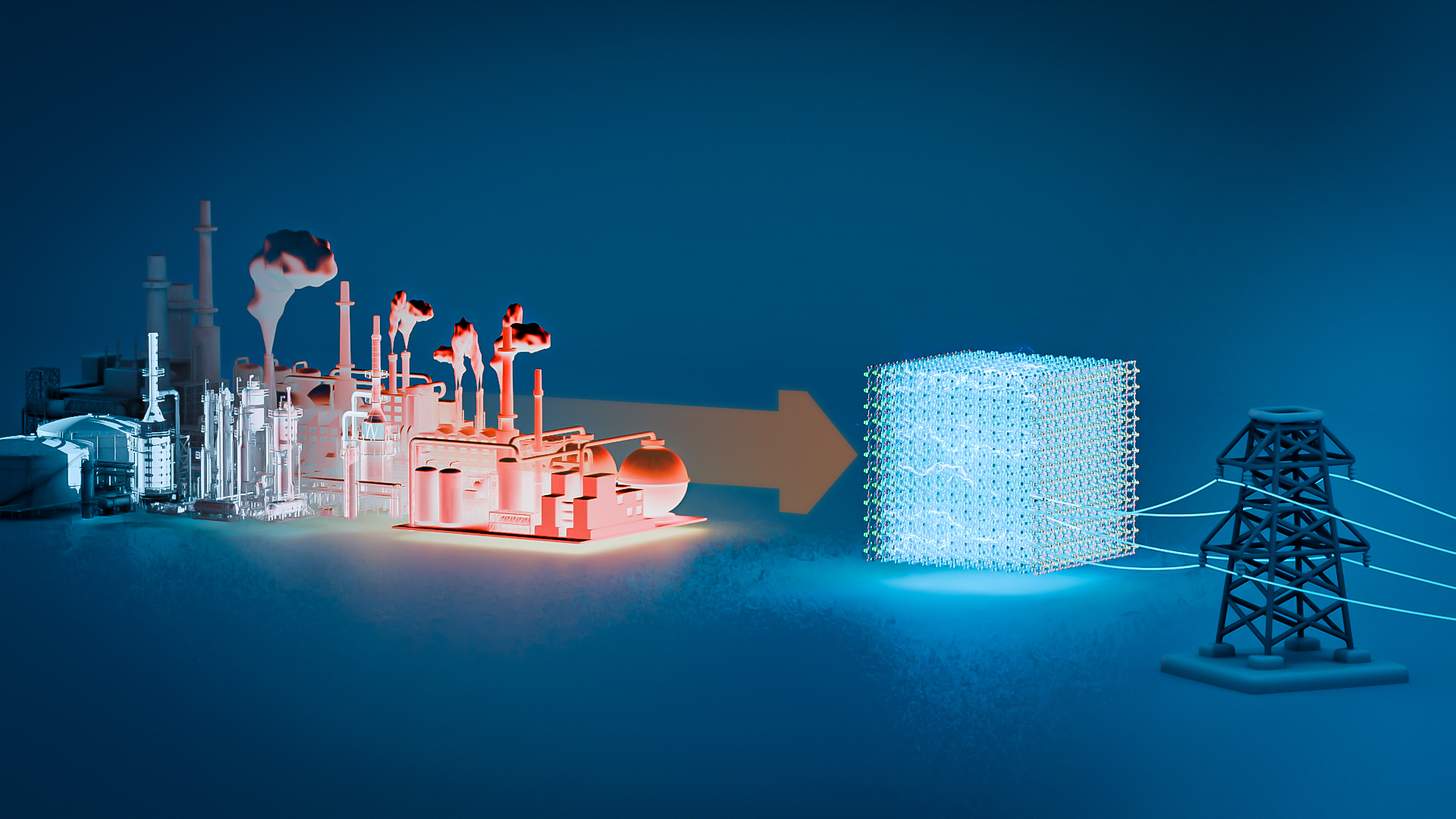
Vanadium-based monolayers with unconventional magnetic properties could help to transform industrial low-temperature waste heat into electric power, a KAUST study demonstrates[1].
Recovering waste heat relies on technologies specifically designed for the waste heat source. Existing technologies range from steam production to thermoelectric generators. Yet, low-temperature waste heat — typically below 500 K and representing more than half of all industrial waste heat — is more difficult to recover than its high-temperature counterpart.
Thermoelectric materials convert a temperature difference into electricity, offering a promising solution for power generation. However, the existing low-efficiency devices for low-temperature waste heat are useful only for niche applications, where reliability, low maintenance, and energy independence are critical, such as in wireless sensor networks in factories and low-power equipment in remote locations.
Magnetism can strongly influence the electronic and thermal transport properties of materials. It can decouple the electronic transport coefficients to increase the thermoelectric efficiency, or figure of merit. It can also boost the thermoelectric efficiency by promoting lattice vibrations — known as phonons, which are quasiparticles that carry heat — thereby hindering heat transfer.
The newly discovered altermagnets, which feature a spin-split electronic band structure — meaning the energy levels for electrons differ depending on their spin direction — and zero magnetization, have received much attention due to their unusual magnetic properties. However, their thermoelectric behavior is unclear.
Now, Udo Schwingenschlogl and coworkers from KAUST have used numerical computations to gain insight into the potential of two-dimensional altermagnets as thermoelectric materials. They investigated the vanadium oxyselenide monolayer V2Se2O and its asymmetrical, or Janus, derivative, in which tellurium atoms replace every other selenium atom.
“The key challenge was capturing the complex coupling between the spin order, lattice vibrations, and heat transport in a two-dimensional material,” Schwingenschlogl says.
To treat these deeply intertwined aspects together, the researchers combined advanced first-principles simulations with the phonon Boltzmann transport equation to assess the lattice thermal transport. “This was computationally demanding but essential to achieve reliable predictions,” Schwingenschlogl adds.
The researchers showed that Janus structures and altermagnets are a powerful combination for tuning the charge and heat transport. The Janus derivative presented lower phonon group velocities, which indicates slower heat transfer, and higher phonon-phonon scattering rates than its symmetrical counterpart, a consequence of the incorporation of the heavier tellurium atoms in its structure.
“This results in a substantial 19-fold reduction of the lattice thermal conductivity and enables efficient thermoelectric power generation,” explains Shubham Singh, a Ph.D. student in Schwingenschlogl’s group and the first author of the study.
For example, the Janus derivative displayed a high figure of merit of 2.7 at 500 K, outperforming commercial lead- and bismuth-based materials. The high thermoelectric efficiency at and below 500 K means that the material is suitable for low-temperature waste heat recovery.
The researchers are exploring other Janus altermagnets to identify efficient and experimentally feasible thermoelectric materials.
They also plan to collaborate with experimental groups to translate these predictions into functional devices. A practical integration would involve growing the monolayers and assembling them into thermoelectric modules. Thanks to their unique properties, the modules would complement existing systems by targeting the low-temperature regime.
Reference
- Singh, S., Rout, P. C., Ghadiyali, M. & Schwingenschlögl, U. V2Se2O and Janus V2SeTeO: Monolayer altermagnets for the thermoelectric recovery of low-temperature waste heat. Materials Science and Engineering R: Reports 166, 101017 (2025).| article.
ABOUT THE AUTHOR
Shubham Singh
Ph.D. student

You might also like
Applied Physics
Colorful solution to advanced disease diagnosis
Chemistry
Turning infrared solar photons into hydrogen fuel
Applied Physics
A single additive enables long-life, high-voltage sodium batteries

Bioengineering
Smart patch detects allergies before symptoms strike
Applied Physics
Interface engineering unlocks efficient, stable solar cells
Applied Physics
The right salt supercharges battery lifespan

Applied Physics
Light-powered ‘smart vision’ memories take a leap forward
Applied Physics