

Chemistry
Catalysts provide the right pathway to green energy
A novel material is shown to be one of the most efficient photocatalysts for solar-driven production of hydrogen peroxide.


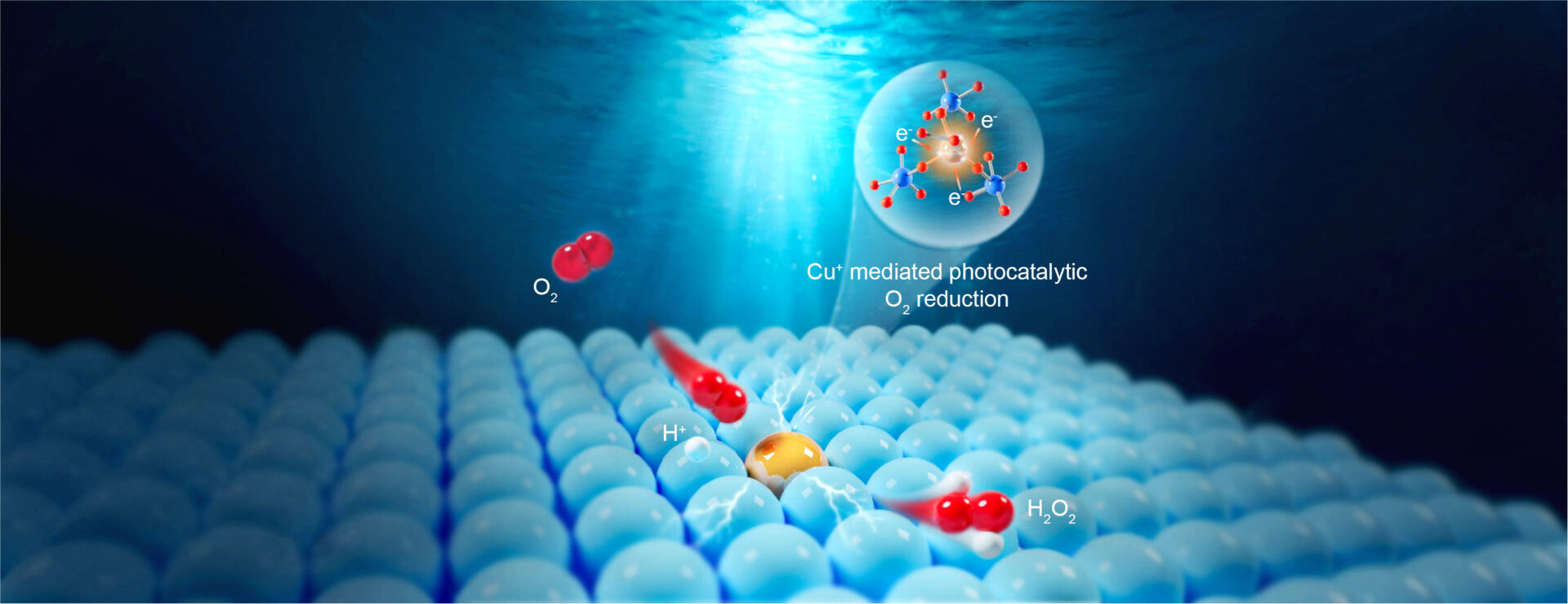
Hydrogen peroxide (H2O2) packs so much chemical energy into a small space that it is powerful enough to fuel rockets. But this same ability to concentrate energy also makes hydrogen peroxide useful for more Earthly energy applications, such as powering fuel cells. It also holds promise as a green and sustainable energy source: when hydrogen peroxide releases its stored energy, the main byproduct is simply water.
Huabin Zhang and his team at KAUST, together with colleagues from China and the United States, have developed a material that significantly boosts hydrogen peroxide production[1]. “We proposed a convenient strategy to regulate the chemical state of a catalyst at the atomic level,” says Chengyang Feng from the KAUST team.
The conventional approach to producing hydrogen peroxide at an industrial scale requires several organic solvents that are toxic to the environment. A far more environmentally friendly approach is to use a sunlight-powered photocatalytic system.
These systems generate hydrogen peroxide directly from water and oxygen in the air, using a semiconductor photocatalyst that harvests solar energy. When exposed to sunlight, the photocatalyst absorbs photons and generates charge carriers — electrons and holes. The photogenerated electrons participate in the oxygen reduction reaction (ORR) at the catalyst surface, reducing oxygen molecules to hydrogen peroxide.
The efficiency of this process is significantly enhanced by optimizing the surface properties of the photocatalyst and its interaction with light.
One major challenge to improving photocatalytic efficiency is that multiple oxygen reduction reactions can occur. The pathway that leads to hydrogen peroxide involves two electrons. But there are other, less helpful reactions. The four-electron process generates water, while one-electron reactions form unstable superoxides. Among these possibilities, water formation is thermodynamically the most favorable, so catalysts need to be engineered to kinetically favor the desired two-electron pathway to hydrogen peroxide.
The photocatalyst developed by the researchers was made using tungsten trioxide (WO₃), which they modified by adding isolated copper atoms. While tungsten trioxide is already a well-known photocatalyst, the team added copper atoms to capture and activate oxygen molecules and to guide the reactions toward the two-electron pathway.
“Compared to previously demonstrated catalysts, our catalyst features well-defined single-atom catalytic sites where the electronic states that drive the chemical reactions are tunable,” explains Feng “This can be readily achieved by adjusting the interaction between the metal sites and the support.”
The team studied several different compositions, but their best-performing photocatalyst produced 102 micromoles of hydrogen peroxide per hour when irradiated by visible light. This is much higher than any previously reported photocatalyst and 17.3 times more than a copper-free tungsten trioxide catalyst.
“The next step in this research is to further optimize the catalyst system under real-world conditions, explore its scalability and long-term operational stability, and investigate its integration into practical devices or processes,” Feng adds.
Reference
- Yang, F., Feng, C., Zuo, S., Wang, Q., Wei, F., Hu, M., Ren, Y., Liu, D., Li, W.-L., Wang, S., Alqahtani, H.S., Ng, Y.H. & Zhang, H. Photocatalytic H2O2 production with >30% quantum efficiency via monovalent copper dynamics. Journal of the American Chemical Society 147, 17112–17120 (2025). | article.
ABOUT THE AUTHOR
Chengyang Feng
Postdoc

You might also like

Chemistry
Opening a window on architectural nano-design
Bioscience
Multi-enzyme pathway delivered into living cells

Chemical Engineering
Natural solvents enable fully bio-based membranes
Chemistry
Turning infrared solar photons into hydrogen fuel
Applied Physics
Natural polymer boosts solar cells

Chemistry
Disruptive smart materials flex with real world potential
Chemistry
Hollow molecules offer sustainable hydrocarbon separation
Chemistry