
Harnessing algae’s green superpowers
Harvesting and processing micro- and macroalgae hold versatile industrial applications and could help meet food security and carbon neutrality goals.


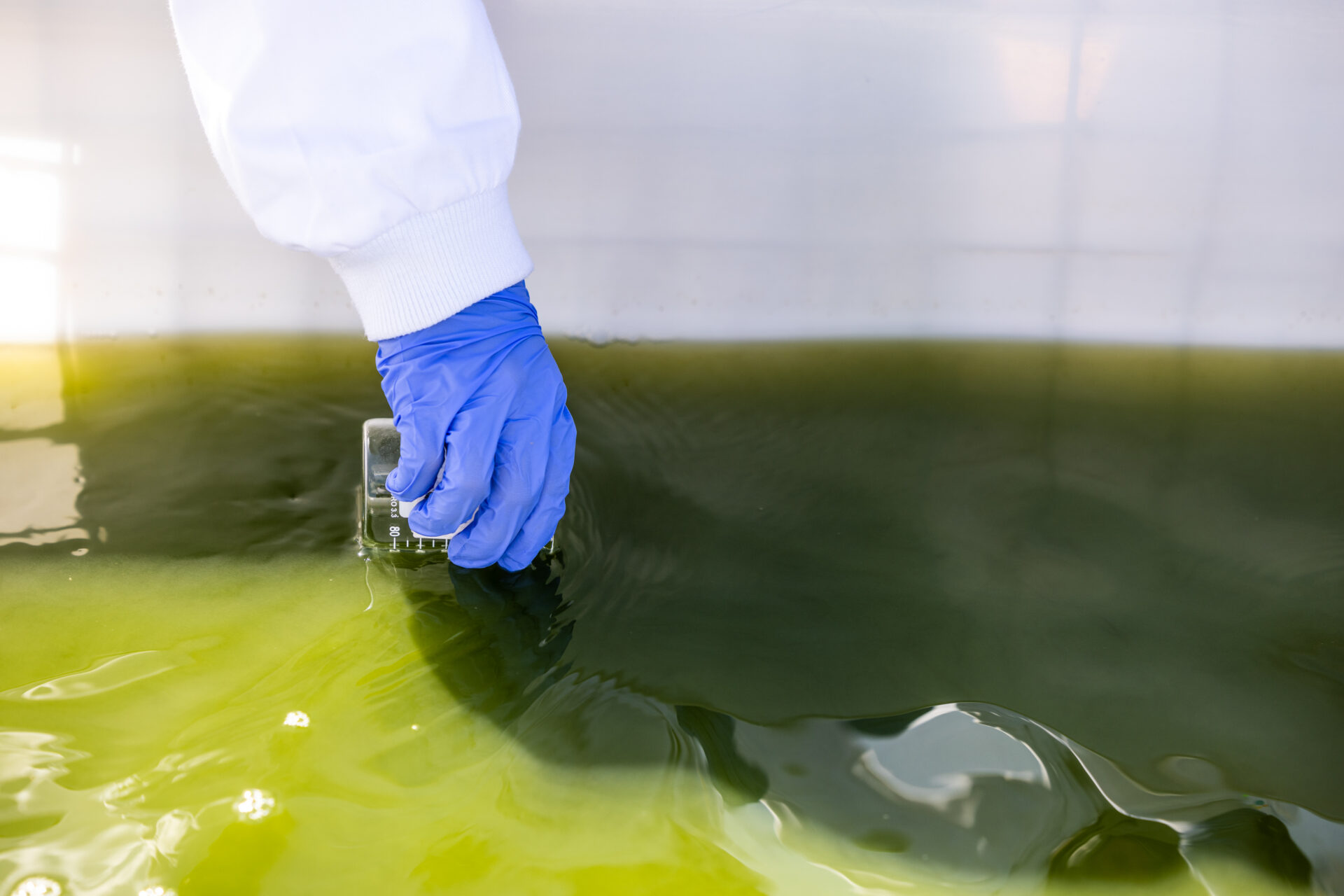
A greener future for Saudi Arabia and beyond may emerge from an unexpected source: algae. Over the past five years, KAUST researchers have laid the groundwork for a new industry in the Kingdom. Their work spans the cultivation, harvesting, and processing of microalgae and macroalgae as sources of sustainable animal feed, biomolecules for medicine, carbon dioxide conversion, and raw materials for textile production for the fashion industry.
“Algae are among the most flexible organisms on Earth,” says Claudio Grünewald, who leads algal research at KAUST. “Algae are key photosynthetic organisms that uptake, utilize and sequester carbon dioxide, and produce copious oxygen. We have a fantastic opportunity to harness the green potential of this highly adaptable organism.”
Grünewald, as project director at KAUST Beacon Development, oversees the advancement of groundbreaking algal technologies and techniques for successful farming of microalgae, and for the processing of wild macroalgae (seaweeds) found along the Red Sea coast.
With microalgae, the biomass generated can be used for industrial and agricultural applications. Macroalgae, meanwhile, are a valuable source of alginate, a polysaccharide used as a thickening and gelling agent. High-quality alginate is widely used in the food industry, while lower-quality grades are used as paint thickeners and in other industrial applications.
Algae cultivation potential in Saudi Arabia
“Saudi Arabia’s landscape and climate offer favourable growth conditions for algal farming,” says Grünewald. “We have the key parameters needed to grow microalgae at scale in semi-controlled environments: flat open spaces, high light radiation, pristine seawater, and sources of excess carbon dioxide.”
Microalgae use carbon dioxide as a main carbon source for photosynthesis that, in turn, generates oxygen, biomass and other valuable compounds. This natural potential to turn emissions into a useful resource opens the possibility for every thermal power plant to incorporate an algal farm as a carbon capture and conversion unit, supporting Saudi Arabia’s target of carbon neutrality by 2060. This vision is being driven by a growing partnership between KAUST and a major multinational company.
Grünewald’s team have built microalgae and seaweed processing facilities at KAUST and also with NAQUA, one of Saudi Arabia’s largest aquaculture companies. They have grown multiple species of microalgae in a wide variety of water types, from fresh water to highly saline brines from desalination plants, and proved that the resulting biomass is quality feed for chickens and fish. Moreover, these organisms can serve as a matrix for plant biostimulant production.
“We’ve tested microalgae bio-stimulants in several crops, including cherry tomatoes and potatoes, and results show that they can improve yields by 30 percent,” says Grünewald. Byproducts from seaweed processing can also be used as fertilizers to improve crop yields.
Building an algae industry
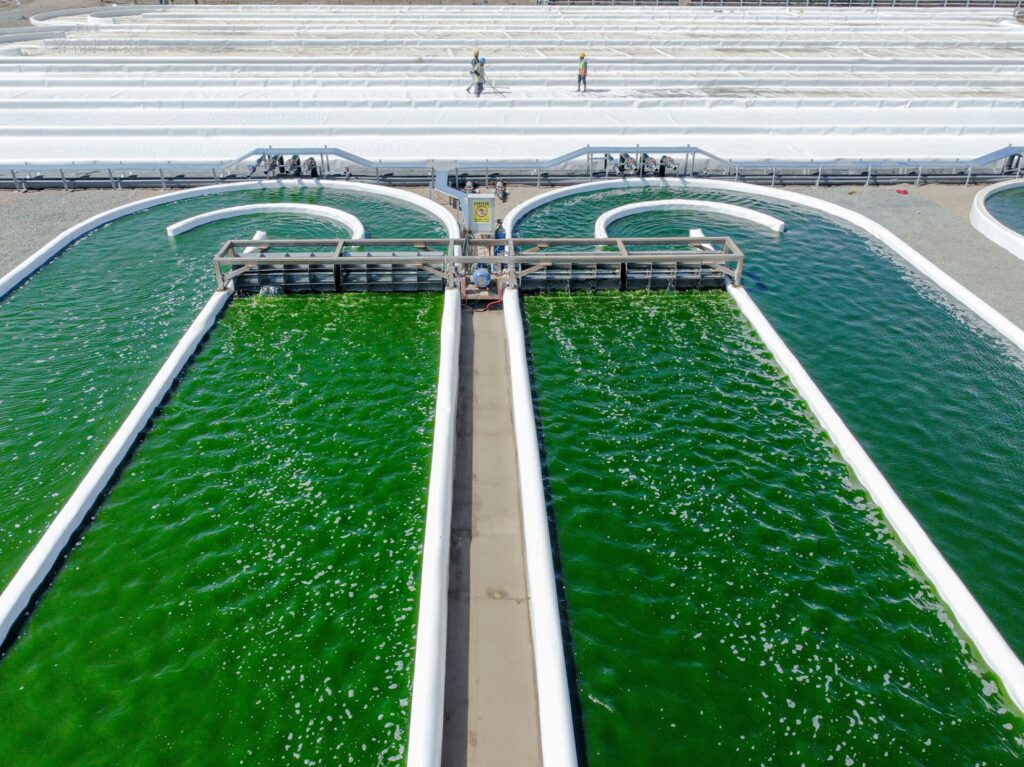
Solid support means that algal farms are spreading across the Kingdom. Since KAUST first began pioneering algal production techniques and technologies in 2021, at least six companies have either established or are in the process of establishing microalgae farms in the country.
“One of our main funders was the Ministry of Environment, Water and Agriculture,” says Grünewald. “We’ve validated our findings under strict environmental guidelines and demonstrated to investors that it is feasible to produce algae biomass at scale here. Both local and international companies are investing in the industry, and we expect algal farming to cover over 300 hectares by the end of 2028.”
All companies must adhere to environmental legislation for farming microalgae. Should any companies decide to grow species that are not native to the region, they must ensure proper treatment and secure growing facilities to avoid exotic species escape, notes Grünewald.
The algae industry will support national food security goals, providing a sustainable, local source of feedstock and fertilizers. It will create jobs and improve local economies by boosting the whole value chain, because the materials used to build and support these facilities are locally sourced.
Seaweed success stories
On the macroalgae side, Grünewald and co-workers have conducted extensive surveys into a brown seaweed called Sargassum, which is particularly prolific along the Red Sea coast. Sargassum flourishes from September to February, following a reproductive phase in late summer. The seaweed washes up in vast quantities along the coast; rotting seaweed is a health hazard, and acidic gases can also leach from the seaweed, degrading the environment and harming wildlife.
“By harvesting and processing Sargassum to produce alginate, there are many positive secondary effects,” says Grünewald. “We’ll employ local fishermen to harvest the seaweed during its peak season, providing incomes and taking the pressure off fisheries for part of the year. Local authorities will save money usually spent on cleaning up seaweed, and tourism will benefit from cleaner beaches. This seaweed also captures a lot of carbon dioxide from the atmosphere, and we can turn this into safe, usable forms of carbon.”
Alginate is currently imported from China in bulk by the food industry in the Kingdom. A secure local source of alginate will further improve food security and support local economies and employment. Before Sargassum processing is rolled out at scale, Grünewald is determined to ensure the harvest does not disrupt Red Sea ecosystems.
“Sargassum ‘forests’ normally grow in shallow water, and provide shelter and habitat to tiny organisms, including coral and fish larvae. We mustn’t disturb them,” says Grünewald. “With KAUST colleagues, we’re conducting research to understand the seasonal cycles of these creatures, and ensure we harvest the seaweed at the correct time each year.”
For now, KAUST is processing Sargassum in a pilot ‘biorefinery’, extracting alginate first, then using the leftover material to make other valuable products. This seaweed can be turned into fibers for making beautiful fabrics, for example.
“Both micro- and macro-algae are surprisingly versatile, and, alongside interested partners from all industries, we’ll continue to explore the uses stemming from algal processing,” says Grünewald.
REFERENCES
Mhedhbi, E., Padri, M., Al Shaikhi, A., Al Hafedh, Y ., Fuentes Grunewald, C. The potential of microalgae to contribute to sustainable animal feed production in the Arabian Peninsula, Saudi Arabia. Applied Phycology 7 (1), 2026. |article
KAUST converts Red Sea seaweed into economic and environmental value. |article
Healing the land to feed the future. |article
Silkina, A., Gayo-Pelaez, J.I., , Fernandes, F., Fuentes-Grünewald, C., Kapoore, R.V., Tang, K.W. From waste to wealth: coupling different nutritional modes of Scenedesmus obliquus for waste remediation and algal product development. Journal of Applied Phycology 37 (2), 2025. |article
ABOUT THE AUTHOR
Claudio Grünewald
Algae Program Director at KAUST Beacon Development
You might also like
Marine Science
Sustainable seafood sources could help close global nutrition gaps
Bioengineering
New gene insertion method for plant engineering
Marine Science
Corals show ‘vaccine-like’ responses after pathogen exposure
Marine Science
Tracing 700 million years of cell evolution

Electrical Engineering
Wearable microneedle patch could improve drug monitoring

Statistics
Smoothing the math of spatial networks

Computer Science
Virtual reality headsets open a window into the mind
Bioengineering