

Chemical Engineering
Engineered membranes made from corn proteins
Biodegradable nanofiltration membranes made from an agricultural byproduct could reduce the environmental impact of industrial chemical purification.


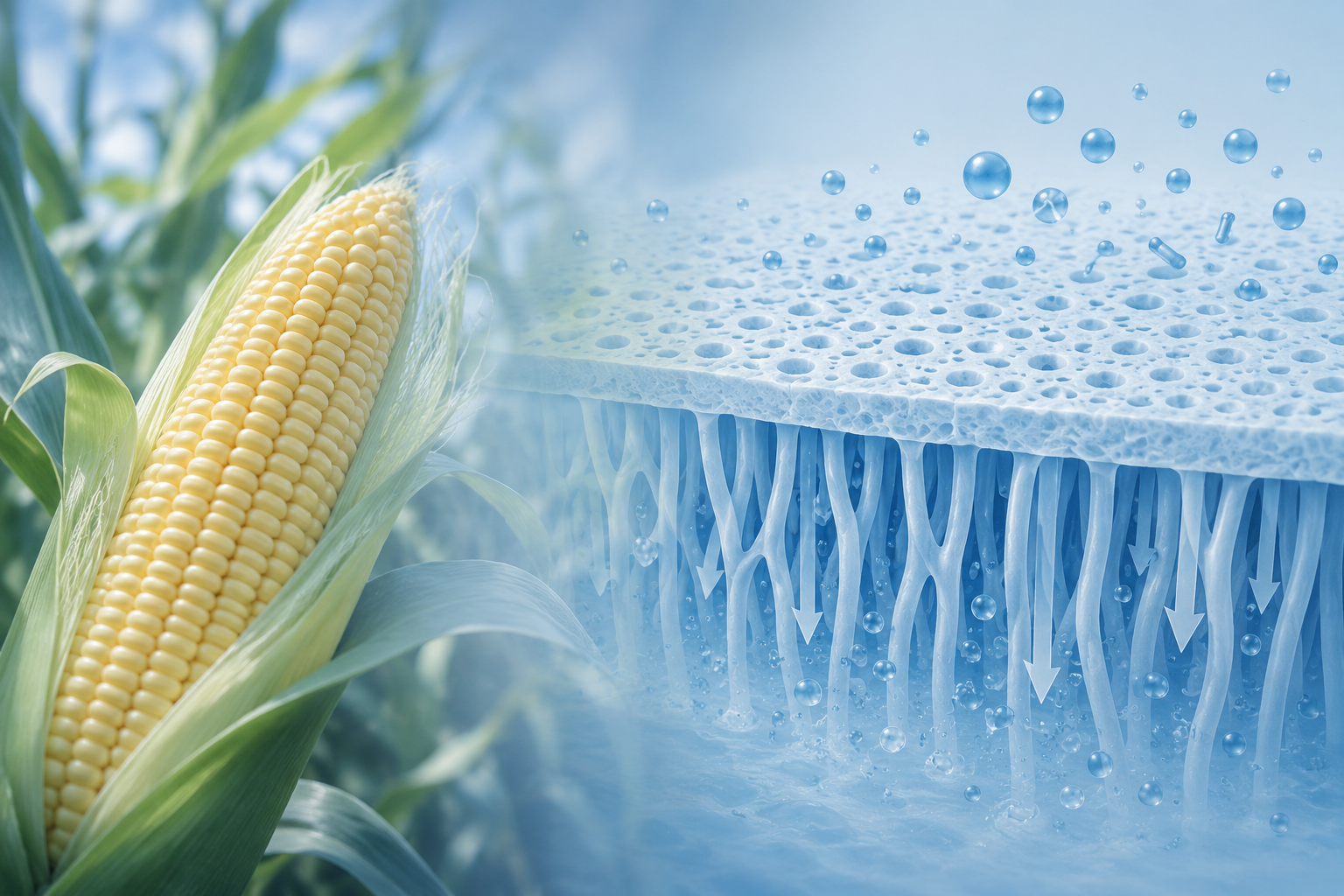
A protein by-product from corn processing could help cut the energy cost of industrial chemical purification. Developed by KAUST researchers, the protein can be made into a biodegradable nanofiltration membrane that separates mixtures of industrial chemicals using a fraction of the energy of traditional purification methods[1].
Chemical separations account for a large share of global industrial energy consumption, typically through large-scale heat-driven processes such as evaporation, drying, or distillation. Molecular sieve membranes are a promising, energy-efficient alternative for industrial chemical purification, using selective nanofiltration rather than heat-driven separation. Adopting membrane technology can cut the carbon emissions of a chemical purification step by up to 90 percent.
Yet despite this promise to decrease industrial energy consumption, nanofiltration membranes themselves are not very green, says Claudia Oviedo, a Ph.D. student in Gyorgy Szekely’s lab, who led the research.
“Most membranes are based on synthetic polymers derived from fossil resources, which raises concerns about their sustainability and long-term environmental persistence,” Oviedo explains. “The motivation of our research is to reduce the dependence on fossil-based membrane building blocks by exploring bio-based alternatives, preferably made from abundant agricultural waste.”
An ideal candidate could be a protein called zein, a widely available byproduct of the global corn processing industry, the team showed. “Zein is particularly promising for membrane materials due to its hydrophobicity,” Oviedo says. This low water solubility was the key to turning zein into a solvent-resistant nanofiltration membrane.
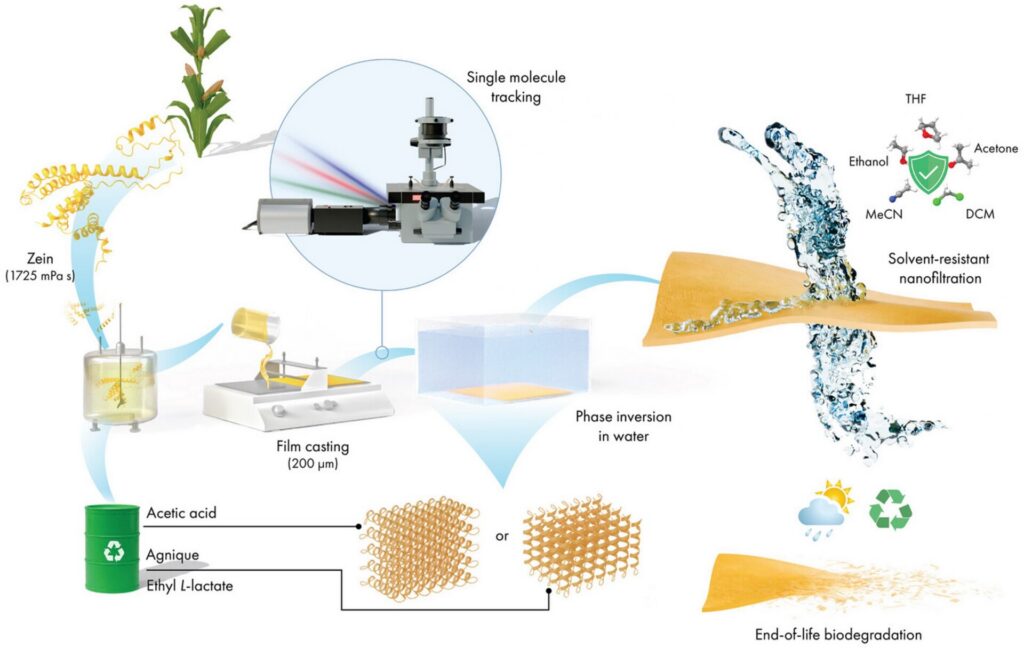
The researchers made their bio-based membranes by dissolving the zein in a green solvent, casting this solution into a thin film, then adding water as a nonsolvent. As water displaced the solvent and the hydrophobic protein chains were squeezed together, they experienced a phenomenon called macromolecular crowding.
“Macromolecular crowding occurs when large molecules are present in high concentrations,” Oviedo says. Repelled by the water, the zein protein chains are forced to interact and organize, packing closely together to form a well-defined structured membrane.
Collaborating with Satoshi Habuchi and his KAUST team, the researchers tracked the process in microscopic detail by adding nanoscale luminous tracers called quantum dots to the starting protein solution.
Once water was added, the quantum dots’ motion gradually separated into two bands, with fast-moving dots in the upper layer and slow-moving dots in the lower layer where the membrane was forming. “This motion indicated the formation of zein-rich and zein-poor domains as the membrane structure developed,” Oviedo says.
Computational molecular dynamics simulations showed that hydrophobic protein-protein interactions drove the zein chains to pack closely and entangle, creating a crowded network where nanoscale pores are surrounded by densely arranged protein chains.
The performance of the new zein membrane’s nanofiltration was competitive with commercial synthetic nanofiltration membranes, the team found, and they used their sustainable membrane material to separate a toxic impurity from a pharmaceutical product.
“Our trials also showed that zein membranes biodegraded rapidly, in contrast to conventional fossil-based membranes that persist in the environment post-disposal,” Szekely says.
The team’s next goal is to evaluate whether bio-based nanofiltration membranes provide lower environmental impacts from cradle to grave. “Our ongoing research focuses on life cycle assessment comparing zein extraction and membrane fabrication with fossil-based membranes,” Szekely says.
Reference
- Oviedo, C., Hardian, R., Oldal, D.G , Holtzl, T., Serag, M., Habuchi, S., Szekely, G. Harnessing macromolecular crowding of proteins for engineering sustainable nanofiltration membranes. SusMat 6, e70070 (2026) | article.
ABOUT THE AUTHOR
Claudia Oviedo
Ph.D. student
You might also like
Chemical Engineering
Fluoride treatment gives catalyst extra bite

Chemical Engineering
Clean jet fuel chemistry takes flight

Chemical Engineering
Natural solvents enable fully bio-based membranes

Chemical Engineering
Urban air pollution goes up in smoke
Chemical Engineering
Rethinking machine learning for frontier science
Chemical Engineering
Magnetic nanoparticles capture microplastics from water
Chemical Engineering
Biogas upgrading goes with a swing
Chemical Engineering