

Electrical Engineering
Gallium oxide electronics withstand extreme cold
Robust semiconductor enables devices to operate close to absolute zero, with potential applications in space missions and quantum computing.


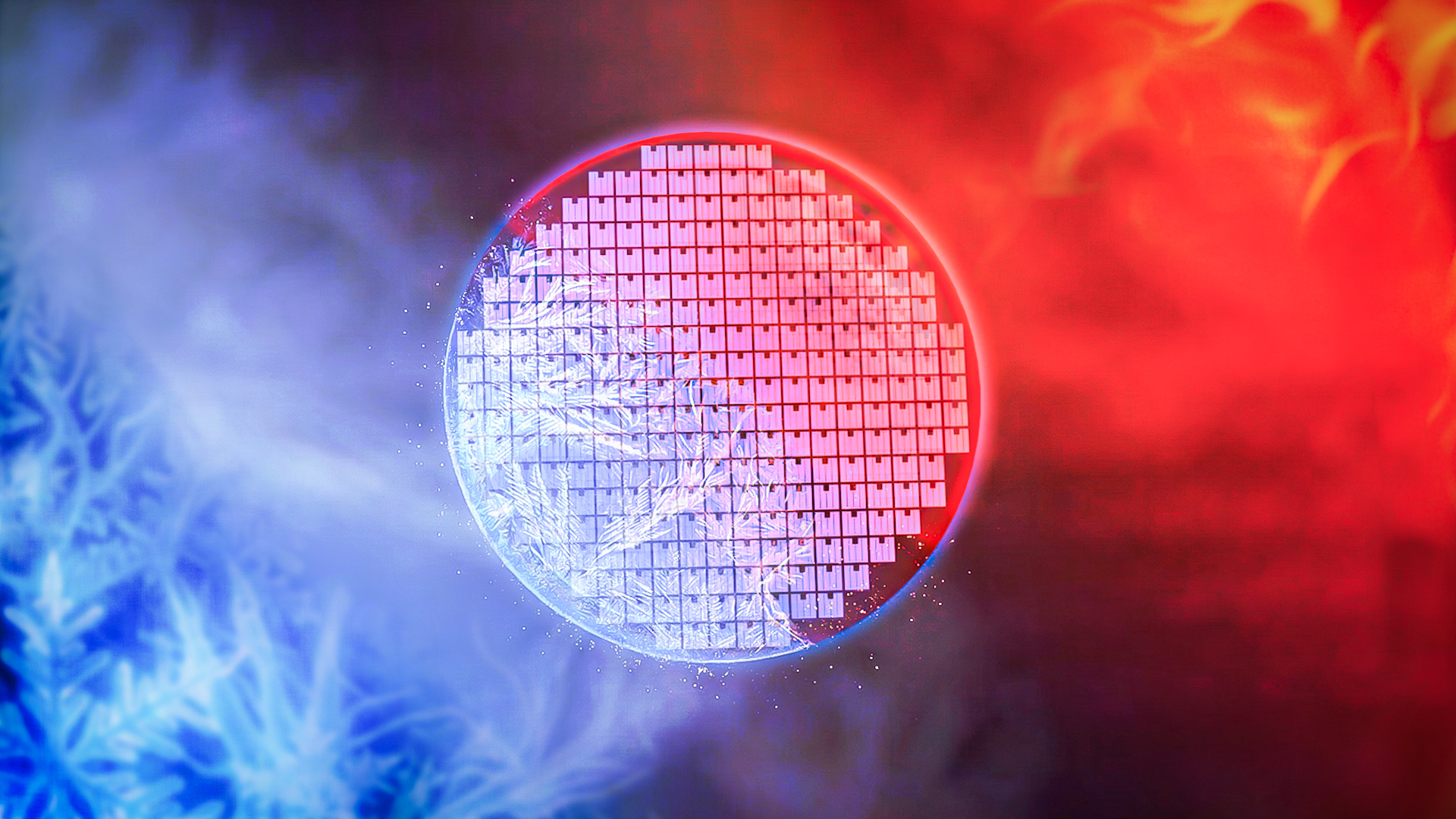
Electronic devices based on gallium oxide can operate at temperatures even colder than deep space, KAUST researchers have found[1]. This capability could eventually support extreme-temperature applications such as quantum computing and space exploration.
Computer chips, sensors, and other electronic systems all depend on semiconductors. These materials have an energy gap, known as the band gap, that electrons must leap to conduct electricity. At low temperatures, however, electrons become trapped and cannot move, a phenomenon known as freeze-out.
“In practice, most conventional electronics start to fail as you go below about 100 K (−173 °C),” says Vishal Khandelwal, a former Ph.D. student in Xiaohang Li’s group, who led experimental work on the new devices.
Since electronics are exposed to far colder temperatures in space, or in quantum computers that run at just 4 K, they require thermal management systems that add cost, bulk, and complexity.
The KAUST team has a long history of research on the ultrawide-bandgap semiconductor beta-gallium oxide (β-Ga2O3), previously demonstrating its resistance to radiation and high temperatures. Its wide bandgap means that devices based on gallium oxide experience less current leakage and keep working even at 500 °C, far beyond the capabilities of ordinary silicon circuits.
Earlier studies also showed that the material does not suffer from the freeze-out effects of other semiconductors. To exploit that effect, the researchers have built two devices based on beta-gallium oxide seeded with silicon atoms. This additive, known as a dopant, supplies electrons that help current to flow in the devices.
The first device is a fin field-effect transistor (FinFET), featuring fin-shaped channels that make it stronger and more stable than conventional field-effect transistors. The second is a logic component called an inverter (also known as a NOT gate), a fundamental building block of computer circuits. Both devices demonstrated reliable performance at just 2 K.
At that temperature, there is almost no thermal energy to help electrons jump into gallium oxide’s conduction band. “Instead, the electrons hop through an ‘impurity band’ created by the silicon atoms, enabling the device to carry a current,” Li explains.
Although these are not the first electronic devices to operate at 2 K, this is the first demonstration of an ultrawide-bandgap semiconductor used to build transistors and logic inverters at such low temperatures. “Practically speaking, it allows the development of compact cryogenic circuits made from one material,” says Li — potentially simplifying electronics in quantum computers.
“But its greatest advantage may be for space applications,” he adds. “Space probes face huge temperature swings, so devices that work from a few K to hundreds of K — like beta-gallium oxide — could reduce the need for bulky thermal protection.”
The researchers plan to use beta-gallium oxide to build a toolbox of other devices, including radio-frequency transistors, photodetectors, and memory cells. “We have demonstrated the basic building blocks,” says Li. “Now the work is to scale this up into complex cryogenic chips and to push the limits of performance in this ultracold regime.”
Reference
- Khandelwal, V., García, G. I. M., Kumar, M., Blanda, F., Xiao, N., Zheng, D., Mainali, G., Rajbhar, M. K., Tang, X., Zhang, X. and Li, X. 2 Kelvin operation of ultrawide-bandgap β-Ga2O3 FinFETs and logic inverter integrated circuits. Nano Letters (2026). | article
ABOUT THE AUTHOR
Vishal Khandelwal
Alumnus

You might also like
Electrical Engineering
Wearable microneedle patch could improve drug monitoring

Electrical Engineering
Laser security system protects online data

Electrical Engineering
Seeing smarter with a light-controlled synaptic device

Computer Science
AI-based hydrogen plant models improve power grid stability
Electrical Engineering
Quantum dot lasers outshine expectations
Bioengineering
Self-aware biosensors boost digital health monitoring
Bioengineering
Smart patch detects allergies before symptoms strike

Computer Science