

Electrical Engineering
Quantum dot lasers outshine expectations
Resilient quantum dot lasers are set to make simpler, greener, and cheaper light-driven integrated circuits.


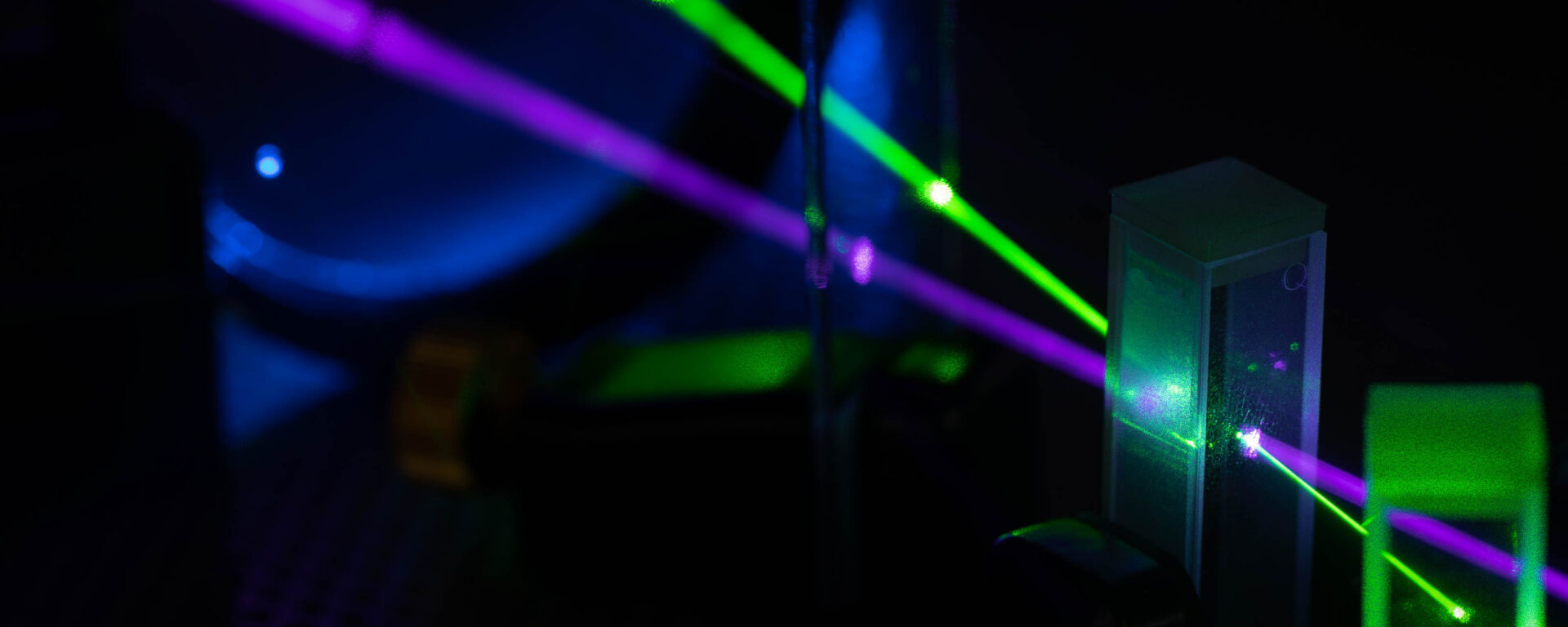
Quantum dot (QD) semiconductor lasers have been shown to operate reliably under strong optical feedback, which results from external light being reflected back from other circuit components[1]. A KAUST-led team says its discovery is the key to simpler and cheaper on-chip integration.
This advance brings these lasers closer to practical use in compact, scalable photonic circuits that enable faster data transfer and processing while using less energy.
Photonic integrated circuits typically use quantum well-based lasers containing III-V-type semiconductor materials like gallium arsenide, which are ideal for long-distance, high-speed data transmission in fiber optic networks. But when incorporated into standard silicon-based circuits, these lasers face specific hurdles. They are highly sensitive to optical feedback, which degrades performance, and can undergo coherence collapse — a chaotic state in which the laser signal becomes unstable and noisy — even under modest feedback levels.
As a result, quantum well-based lasers typically require optical isolators, which allow light transmission in just one direction, or complex engineering to prevent feedback when used on circuits. These protective measures add cost, complexity, and energy consumption.
In contrast, QD lasers are thermally stable, efficient, and resistant to optical feedback thanks to their ability to maintain a consistent, narrow-linewidth signal. This could eliminate the need for optical isolators, simplifying packaging and reducing costs. But, can the lasers stay reliable without isolators in real circuits, where reflections can be much stronger?
The research team — led by Yating Wan, with postdoc Ying Shi, and coworkers from KAUST and the University of California, Santa Barbara — have developed a laser setup to establish a realistic and quantitative feedback limit that system designers can rely on.
“We needed to push QD lasers far beyond previously explored regimes and directly observe where they finally become unstable,” Shi says.
The researchers coupled the QD gain medium with a Fabry-Perot cavity, a simple arrangement of mirrors and optical elements that allowed them to isolate the properties that govern feedback tolerance.
“Using this design ensured any improvements in feedback tolerance truly come from the quantum dot material itself, rather than from added cavity engineering,” Shi adds.
The system withstood feedback levels up to −6.7 dB before collapsing, which is tens of decibels better than standard quantum well-based lasers. “This confirmed that QD lasers are not feedback immune, yet they remained remarkably stable just below this limit,” Shi explains.
Even near the collapse threshold, the laser could transfer data at a sustained, maximum speed of 10 gigabits per second without significant performance degradation. It also maintained strong thermal stability, long-term stability, and reproducibility.
The system performed as well as hybrid platforms, which combine two microchips, and outperformed current state-of-the-art devices in feedback tolerance. Modeling revealed that coherence collapse is influenced by the external cavity length and circuit design, providing practical guidance for building photonic circuits that don’t require optical isolators.
“We are extending this work to application-oriented devices, such as narrow-linewidth and mode-locked quantum dot lasers,” Wan says. The team ultimately aims to develop robust, energy-efficient, and fully isolator-free circuits for emerging applications, such as LiDAR and optical computing.
Reference
- Shi, Y., Dong, B., Ou, X., Prokoshin, A., Shang, C., Bowers, J.E. & Wan, Y. Exploring the feedback limits of quantum dot lasers for isolator-free photonic integrated circuits. Light: Science & Applications 15, 96 (2026).| article.
ABOUT THE AUTHOR
Ying Shi
Postdoc

You might also like
Electrical Engineering
Wearable microneedle patch could improve drug monitoring

Electrical Engineering
Laser security system protects online data

Electrical Engineering
Seeing smarter with a light-controlled synaptic device
Electrical Engineering
Gallium oxide electronics withstand extreme cold

Computer Science
AI-based hydrogen plant models improve power grid stability
Bioengineering
Self-aware biosensors boost digital health monitoring
Bioengineering
Smart patch detects allergies before symptoms strike

Computer Science