

Computer Science | Electrical Engineering
Green quantum computing takes to the skies
Deploying advanced computers on floating platforms in the stratosphere could save on cooling costs.


Quantum computers have the potential to transform key areas of technology, but their fragile quantum states must be maintained at extremely low temperatures using energy-hungry cryogenic cooling systems. This requirement poses one of the biggest barriers to scaling up the technology.
Conventional computers store and process data in bits—zeros or ones—whereas quantum computers use qubits that can exist in multiple states at once. This superposition enables quantum devices to solve certain problems far more efficiently than classical computers, for example, in finance, cryptography, and chemical engineering. However, it also makes qubits extremely sensitive to temperature fluctuations and other environmental noise.
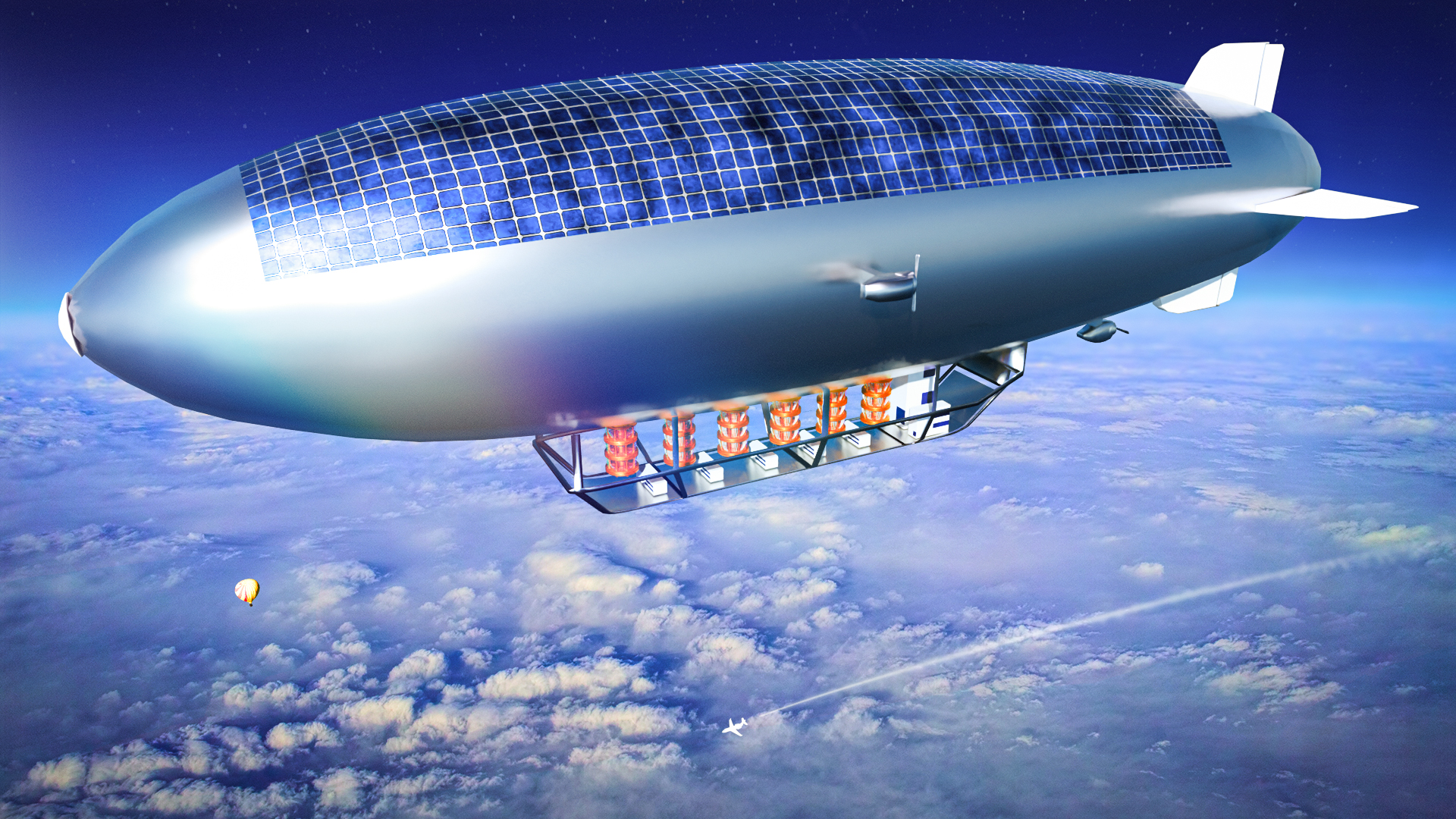
KAUST researchers now propose an unconventional solution: hosting quantum processors on airships cruising through the stratosphere at an altitude of around 20 kilometers, where temperatures can drop to –50°C. These naturally cold conditions could significantly reduce the energy needed for cooling[1].
“By operating above the clouds and weather systems, the airship has access to predictable and unimpeded solar irradiance,” says Basem Shihada of KAUST, who led the team.
To take advantage of the cold, stable conditions of the upper atmosphere, the KAUST team proposes Quantum Computing-Enabled High Altitude Platforms (QC-HAPs) — stratospheric airships equipped with solar panels and lithium–sulfur batteries to keep the systems running through the night.
HAPs would link to quantum data centers on the ground by sending information encoded in light waves, a technique known as free-space optical communication, with radio-frequency links serving as backup during cloudy conditions. To prevent signal degradation as the data travels through the atmosphere, the transmission could be relayed via intermediate, balloon-borne platforms at lower altitudes.
The researchers calculated the amount of energy that could be saved by applying this approach to two leading forms of quantum computing. One uses qubits based on trapped ions cooled to approximately 10 K (–263°C), while the other uses superconducting circuits operating at temperatures below 20 mK.
They found that the QC-HAP concept offers the greatest benefits for ion trap qubits, potentially reducing the energy consumption of cooling systems by 21% compared with equivalent quantum computing centers on the ground. The platforms could also support 30% more qubits than a ground-based system using the same amount of energy. The researchers calculate that cosmic rays — high-energy particles from space — would have a negligible impact on the reliability of stratospheric quantum computing systems.
QC-HAPs could be moved wherever they are needed, and linked together to increase overall computing power, forming “a dynamic fleet capable of delivering on-demand, scalable quantum computation services worldwide”, says Wiem Abderrahim, formerly part of Shihada’s team and now a research fellow at the University of Carthage in Tunisia.
However, the QC-HAP system would depend on significant advances in quantum computing hardware, such as robust systems to detect and correct errors in the qubits, particularly during transmission.
“Our next steps are to move from the conceptual and analytic stage toward more implementation-focused studies,” says Osama Amin, a research scientist in the team.
Reference
- Abderrahim, W., Amin, O. & Shihada, B. Green quantum computing in the sky. Wireless Technology 1, 5 (2025). | article.
You might also like

Electrical Engineering
Wearable microneedle patch could improve drug monitoring

Computer Science
Virtual reality headsets open a window into the mind

Electrical Engineering
Laser security system protects online data

Applied Physics
Colorful solution to advanced disease diagnosis

Electrical Engineering
Seeing smarter with a light-controlled synaptic device

Bioscience
Can AI finally bring order to biology’s data deluge?
Electrical Engineering
Gallium oxide electronics withstand extreme cold

Computer Science