

Bioengineering | Electrical Engineering
Self-aware biosensors boost digital health monitoring
Intelligent system actively self-checks biosensor-skin connections to secure better quality health data.


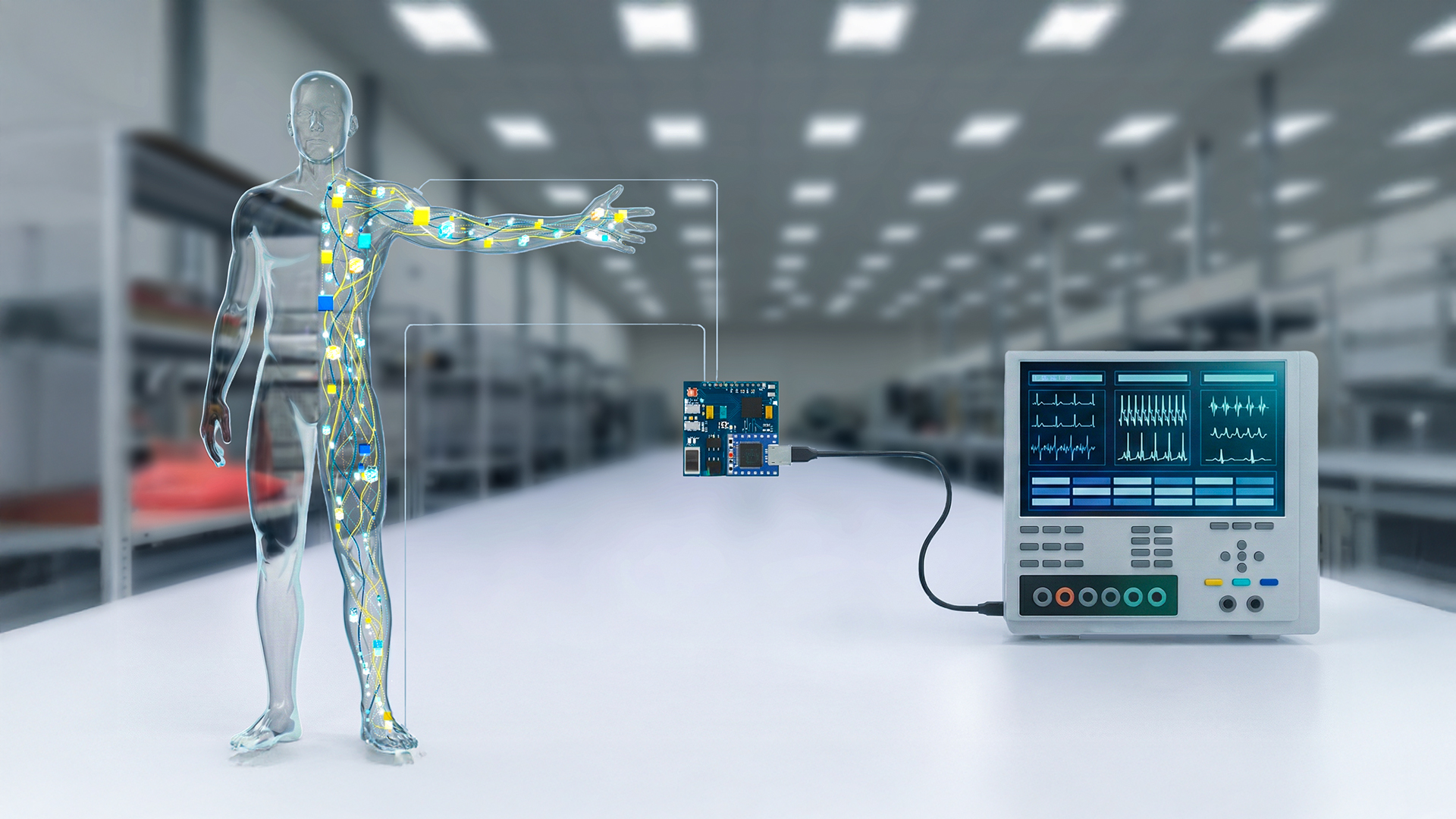
Smart biomedical devices are transforming modern healthcare, using skin-mounted sensors to capture in-depth health information directly from the body. As clinicians increasingly use biosensing devices to guide patient care, accurate and reliable signal acquisition is critical.
A new system that can rapidly detect when the electrodes of devices such as heart monitors start to detach from the skin has been developed by a team at KAUST[1]. Unlike indirect electrode monitoring techniques, the new system directly measures electrode integrity by evaluating digital signal quality between electrodes.
“Traditional methods for checking whether medical electrodes are properly attached, based on impedance or indirect monitoring, were developed many years ago and assume relatively stable conditions,” explains Rajat Kumar, a student in the lab of Ahmed Eltawil, who led the research.
But in real life, as people move and sweat, electrodes can partially loosen or intermittently lose skin contact, which traditional indirect monitoring methods can struggle to detect.
“This is especially problematic for home-based wearable medical devices, where poor electrode contact may go unnoticed for long periods, leading to inaccurate data being recorded and relied upon,” says Abdelhay Ali, a postdoc in Eltawil’s group.
To develop smarter electrode connection monitoring, the team rethought the role of the body itself, Eltawil says. “Instead of treating the body as something that interferes with measurements, we considered whether it could be part of the solution.”
Tiny electrical signals can safely pass through the body, previous research has shown. “We realized that if electrodes could exchange digital signals through the body, then the quality of that communication would directly reflect how well the electrodes were attached,” Kumar says.
The team tested the concept by building a system around a custom chip designed and developed at KAUST. The chip sends and receives tiny digital signals between electrodes placed across the body. A small processing unit then analyses how well each signal is received. “Clear signals indicate good electrode skin contact; small errors indicate weakening contact; and missing signals indicate disconnection,” Ali explains.
A final electronic component manages the electrode checking sequence, ensuring the system can automatically monitor multiple electrodes without interrupting medical measurements.
The team tested the system using electrode pairs attached to human skin, and showed it could clearly differentiate electrodes that were firmly attached, partially loose, intermittently losing contact, or completely disconnected. “Importantly, the system detected the early signs of contact degradation that traditional methods often miss,” Kumar says.
“The system’s very low power consumption should enable practical integration with wearable medical devices that need to run continuously for long periods,” adds Ali. “These components form a compact and efficient solution that can be added to existing medical devices with minimal changes.”
The team now plans to turn their laboratory prototype into a fully integrated, single-chip system that can monitor many electrodes simultaneously, for use in clinical devices such as multi-lead heart monitors.
“Ultimately, our goal is to translate this KAUST-developed technology into practical medical devices that are more reliable, more trustworthy, and better suited for continuous health monitoring in the clinic and at home,” Eltawil says.
Reference
- Kumar,R., Ali, A., Celik, A. & Eltawil, A.M. Real-time BioContact assurance and status monitoring using human body communication. Results in Engineering 29, 108456 (2026).| article.
ABOUT THE AUTHOR
Rajat Kumar & Abdelhay Ali
Ph.D. student & Postdoc

You might also like

Bioengineering
New gene insertion method for plant engineering
Electrical Engineering
Wearable microneedle patch could improve drug monitoring
Bioengineering
Nanoscaffolds to support the fight against superbugs

Electrical Engineering
Laser security system protects online data

Bioengineering
Smaller and sharper: Compact CRISPR scissors cut with precision

Electrical Engineering
Seeing smarter with a light-controlled synaptic device
Bioengineering
Intelligent vision chip offers brainlike processing
Electrical Engineering