

Bioscience
Mica enables simpler, sharper, and deeper single-particle tracking
A simple mica-based method boosts the tracking precision and depth of single particles without the need for complex hardware.


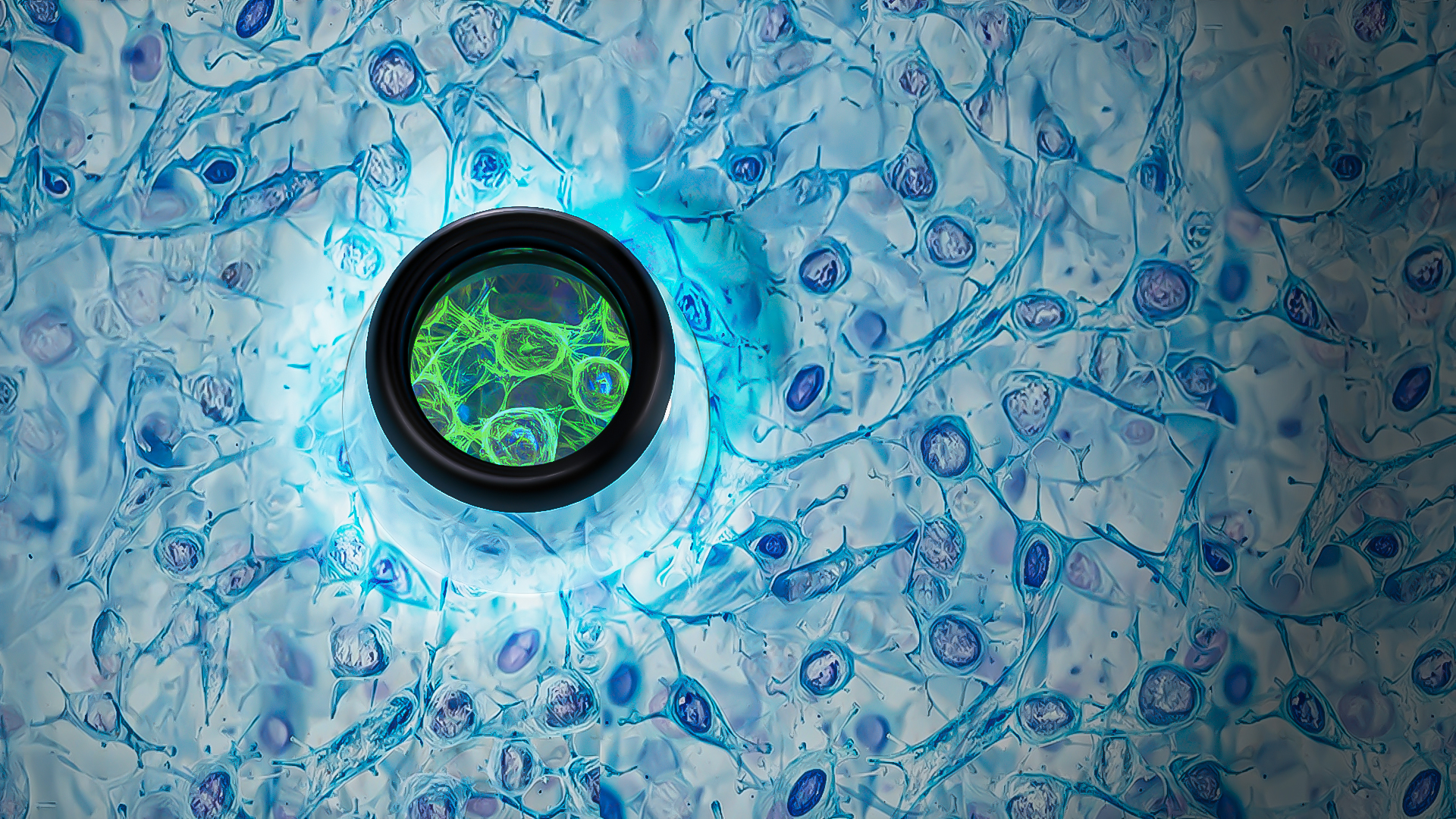
A three-dimensional imaging method utilizes substrates that are birefringent — they have different refractive indices along different crystal axes — to enhance the precision and depth of single-particle tracking, eliminating the need for high-tech hardware. Developed by KAUST, the user-friendly method is compatible with a standard fluorescence microscope and makes molecular motion in complex environments easier to visualize — a potential research tool for general users[1].
Three-dimensional single-particle tracking enables the direct characterization of molecular motion in complex environments. In life science, it provides a crucial understanding of the motion and associated behavior of biological molecules and complexes in cells. This includes the cellular uptake of viruses and DNA hybridization.
Most tracking approaches determine the spatial coordinates of individual particles by creating a unique pattern, known as the point spread function (PSF). This represents what the microscope ‘sees’ for a single point of light, which requires placing additional tools, such as spatial light modulators, in the detection path of the microscope. This creates various patterns depending on the axial position or depth of the particles, revealing their location.
“This is very useful but involves special knowledge and a sophisticated, custom-built microscope,” says principal investigator Satoshi Habuchi.
Now, a team led by Satoshi Habuchi and Shuho Nozue has devised a convenient tracking method that uses mica plates as substrates. The method does not require a customized microscope; instead, the birefringent substrates modify the way light propagates, generating axial-position-dependent patterns.
An evaluation of the substrates’ performance showed that fluorescent nanoparticles supported by mica produced distinct, non-concentric patterns that changed depending on their axial position. The method performed well, achieving a maximum axial tracking range of 30 micrometers with a localization precision exceeding 30 nanometers, surpassing conventional tracking techniques.
“We knew that mica substrates could distort the PSF because of their birefringence, but had no idea whether the distortion could be used for PSF engineering,” Habuchi says. “We were amazed by the large tracking range.”
Simulations by a group led by colleague, Ying Wu, perfectly matched the observed axial-position-dependent PSF, confirming the role of birefringence in PSF distortion.
Variations in the substrate thickness also altered the patterns by affecting the axial range. A thicker substrate led to an axial-position-dependent PSF at a larger axial range, resulting in a larger axial tracking range and vice versa.
Habuchi explains that, depending on tracking experiment requirements, this allows users to choose mica substrates of different thicknesses that exhibit an axial tracking range matching the sample thickness.
The researchers demonstrated that their method could localize and track nanoparticles in live cells for an axial range of more than 20 micrometers. They clearly captured the three-dimensional trajectory of an individual nanoparticle and localized multiple nanoparticles in plant cells, which are much larger and more challenging to examine by fluorescence microscopy than animal cells.
This suggests that the new method can provide insight into the spatiotemporal dynamics of target molecules and the delivery of external materials, such as genetic materials for genome editing, into plant cells, as well as motion in multicellular systems, such as biological tissues.
The team is now working to identify birefringent materials that outperform mica, streamlining the image processing pipeline using deep learning, and expanding the method’s capabilities to three-dimensional orientations.
Reference
- Nozue, S., Ali, R., Wu, Y. & Habuchi, S. Long axial range 3D single-particle tracking using birefringent substrates. Nature Communications 16, 6728 (2025).| article.
ABOUT THE AUTHOR
Shuho Nozue
Research specialist

You might also like
Applied Physics
Colorful solution to advanced disease diagnosis
Bioscience
Multi-enzyme pathway delivered into living cells
Bioscience
Brain fuel also helps wire neural connections
Bioscience
Single small-molecule model reveals insights into human embryo development

Bioscience
Can AI finally bring order to biology’s data deluge?
Bioengineering
Bio-inspired network structures for next-generation AI

Bioscience
Robust workflow built for chemical genomic screening
Bioscience