

Marine Science
A place to trial hope for global reef restoration
Field trial results from an underwater research laboratory located off the Red Sea coast show promise for microbial-based coral reef restoration.


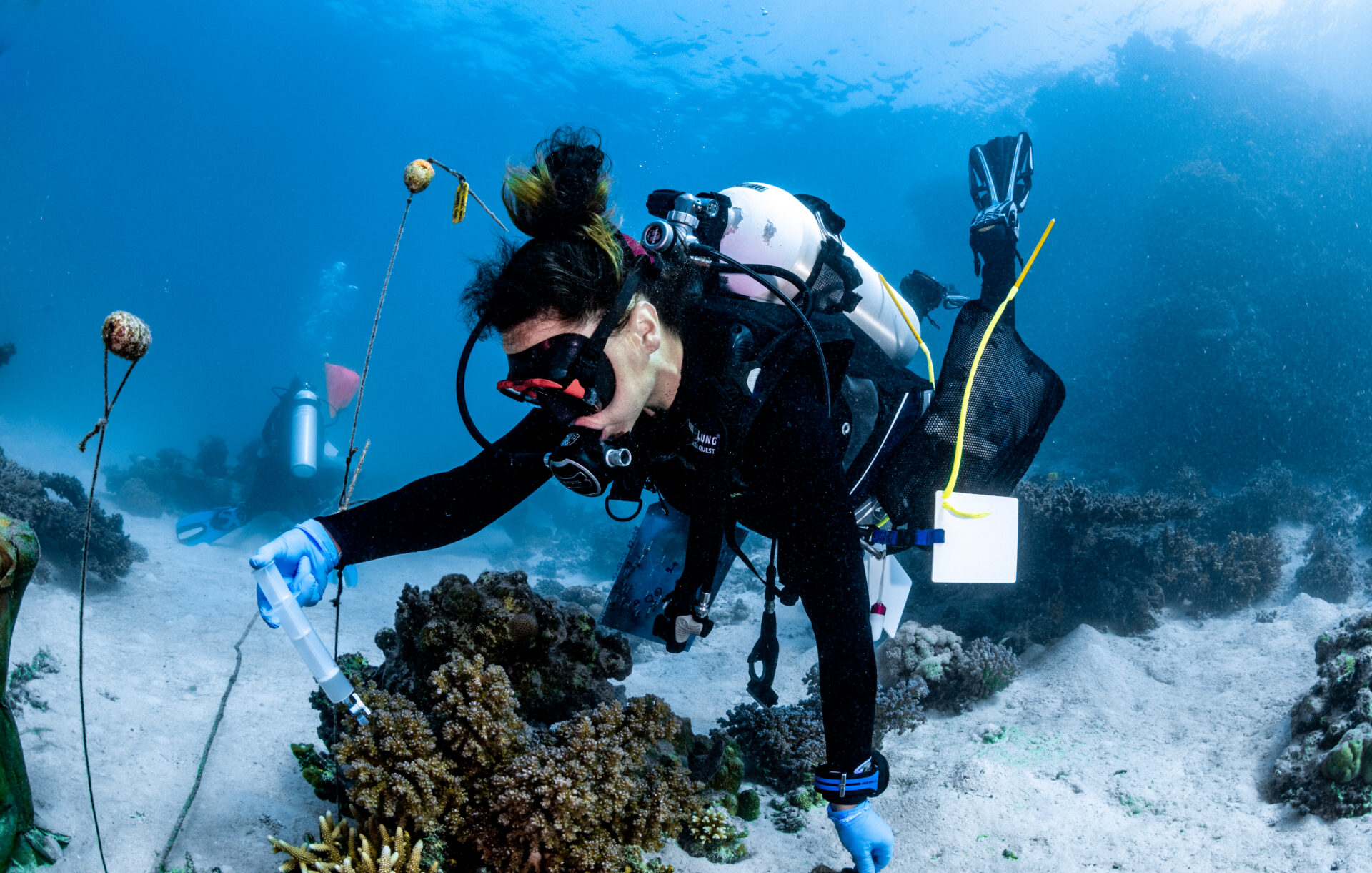
In the urgent search to find scalable, science-based solutions to the global coral reef crisis, there is a demand for robust ways to test these interventions that bridge the gap between laboratory and field experiments. In 2021, this prompted an international team of scientists, led by KAUST researchers, to establish a functional underwater research laboratory on a natural coral reef in the Red Sea that could provide a space to trial coral adaptation options.
Called the Coral Probiotics Village (CPV), this facility enables scientists to test and monitor the success of administering probiotics for corals in a real-world reef environment, among other innovative solutions to restore coral reefs. The first results from projects conducted at the CPV show glimmers of hope for future reef conservation efforts.
“Coral reefs are declining at alarming rates, and the mass coral bleaching event in 2024 had devastating effects worldwide,” says Neus Garcias-Bonet at KAUST, who was involved in developing the CPV with KAUST colleagues. “The CPV provides the perfect capabilities and closely monitoring frameworks to test probiotics and other coral restoration tools under real ocean conditions.”
Coral probiotics boost the corals’ own natural symbiotic microbes, or ‘good bacteria’, to help them remain resilient and healthy in the face of warming oceans. Coral probiotics have gained traction in recent years and show promise in laboratory trials. However, testing this solution on actual ocean reefs remained challenging.
The team presented the design, establishment and full scientific validation of the CPV in a paper published in Ecology and Evolution in 2025, offering a blueprint for other, similar underwater laboratories to be built across the world[1]. “We believe that the CPV provides a reproducible model for testing of integrated reef restoration,” says Garcias-Bonet.
For the CPV, the researchers designed and built a diverse and continuous surveillance platform capable of tracking underwater conditions and thermal trends across different years, so that probiotics can be administered quickly and effectively. They are also developing integrated underwater sensor networks and AI-assisted reef monitoring, together with autonomous vehicles and technologies, in order to gather robust data during all projects conducted at the CPV.
The first projects conducted at the CPV – led by KAUST’s coral probiotics expert Raquel Peixoto – expanded initial successful lab trials on coral probiotics out into the reef.
“We were delighted with the successful completion of the first field trials of coral probiotics at the CPV,” says Peixoto. “These trials demonstrated that beneficial microbes can be safely incorporated by corals, improving their health and resilience without causing harm to other reef organisms or the surrounding environment. Remarkably, we also observed that treated corals helped protect nearby reef life, suggesting potential for broader ecosystem-level benefits.”
These results position the CPV as a scientifically robust platform for advancing reef restoration and conservation, notes Peixoto. As the laboratory is clearly mapped and well signposted, with named streets and zones, it also serves as an excellent tool for outreach and education.
“We envision the CPV as a long-term, multi-disciplinary research hub that enables the rigorous testing and refinement of microbial therapies and other advanced coral reef-assisted restoration-guided technologies,” says Garcias-Bonet. “The CPV offers a pathway to accelerate the development, validation, and deployment of interventions at meaningful ecological scales.”
Reference
- Garcias-Bonet, N., Villela, H., García, F.C., Duarte, G.A.S., Delgadillo-Ordoñez, N., Raimundo, I., El-Khaled, Y.C., Santoro, E.P., Bennett-Smith, M., Nieuwenhuis, B.O., Curdia, J., Zgliczynski, B., Edwards, C., Sandin, S., Osman, E.O., Sicat, R., Przybysz, A., Rosado, A.S., Jones, B.H., Benzoni, F., Berumen, M.L., Salama, K., Park, S., Aranda, M., Duarte, C.M., Schmidt-Roach, S., Hauser, C.A.E., Truscott, T., Suggett, D.J., Voolstra, C.R., Carvalho,S. & Peixoto, R.S. The Coral Probiotics Village: An underwater laboratory to tackle the coral reefs crisis. Ecology & Evolution 15, e71558 (2025).| article
ABOUT THE AUTHOR
Neus Garcias-Bonet
Research scientist

You might also like
Marine Science
Sustainable seafood sources could help close global nutrition gaps
Marine Science
Corals show ‘vaccine-like’ responses after pathogen exposure
Marine Science
Tracing 700 million years of cell evolution
Marine Science
Mapping movements of marine megafauna shows protection must go further
Marine Science
Red Sea coral absorbs chemical contamination
Marine Science
Buying time for coral reefs
Marine Science
Measuring spatial differences in reef-building corals to guide future management
Marine Science