

Earth Science and Engineering
Asymmetric surface deformations reveal ongoing processes after earthquakes
Detailed satellite radar data highlight underlying post-seismic processes at work in the Earth’s subsurface following the 2023 Kahramanmaraş earthquakes.


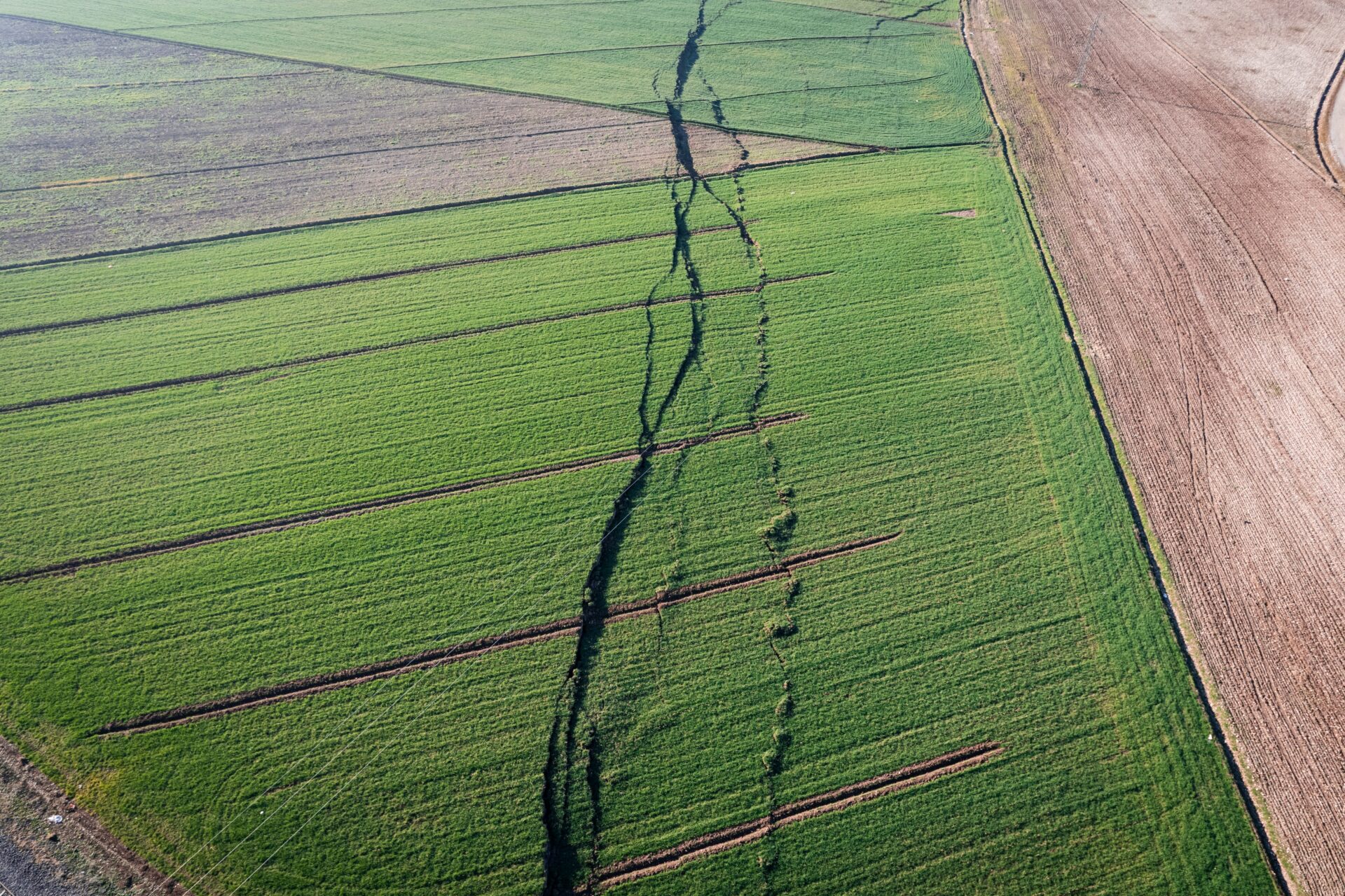
Following the devastating magnitude 7.8 and 7.6 Kahramanmaraş earthquakes in south-central Turkey and northwestern Syria in 2023, KAUST researchers and an international team have conducted a pioneering study into post-seismic deformation across the region. The work was enabled by exceptionally comprehensive satellite radar datasets. Their results underscore the importance of considering both temporal and 3D spatial data in exploring lithospheric recovery[1].
In the aftermath of major earthquakes, the Earth’s crust and uppermost mantle (the lithosphere) continue to deform and shift at plate boundaries, taking time to recover. Monitoring post-seismic surface deformation can help scientists understand which associated subsurface recovery processes occur after earthquakes, and offer insights into possible future tectonic movements.
“Unlike most large earthquakes that occur under the ocean, this massive and shallow earthquake doublet occurred on a continental plate boundary,” says Jihong Liu, research scientist who worked on the study under the supervision of Sigurjón Jónsson. “Having land surface on both sides of the fault allowed us to make detailed deformation observations using interferometric synthetic aperture radar (InSAR) images.”
“The tragedy is that while these types of earthquakes are incredibly useful for scientists, they are generally also the deadliest, causing widespread destruction and loss of life,” says Jónsson. The Kahramanmaraş earthquakes killed more than 50,000 people along the plate boundary (the East Anatolian Fault) between the Arabian Plate and the Anatolian Plate.
Scientists have long tried to ascertain different potential recovery processes in the lithosphere after large earthquakes, but their visible effects are similar, making it difficult to distinguish between the deformation processes at play. Using detailed InSAR images of the region, the team mapped the full spatial pattern and evolution of surface deformation in the first two years after the earthquakes. They then modeled the most likely processes that would result in these deformation patterns. The underlying plate geology helped narrow down the model, as Liu explains:
“Broadly speaking, the Arabian Plate is stiffer and more uniform, with relatively little internal seismic activity. In contrast, the softer Anatolian Plate contains a complex and fragmented fault network and is actively deforming.”
The team found that the deformation across the fault is asymmetric not only in space but also in time, with the two sides relaxing at markedly different rates. This provides critical evidence that the dominant post-seismic process is contrasting viscoelastic relaxation in the different rocks beneath the surface. Viscoelastic relaxation is the gradual release of stress over time inside a material that has been stretched or squeezed.
“Only this process can reproduce what we see on the surface here,” says Liu. There are also indications of poroelastic rebound, where groundwater fluid pressure recovers in pores in the rocks following the earthquake shock, causing gradual uplift in some areas and subsidence in others.
“These results are probably the best example to date in determining post-seismic recovery processes after a major earthquake,” explains Jónsson. “The constraints will directly support more reliable seismic hazard assessments for this tectonically active region.”
The team plans to continue monitoring the fault zone and will use their modeling framework to examine other large earthquakes around the world.
Reference
- Liu, J., Jónsson, S., Li, X., Yao, W., & Klinger, Y. Interplate rheological contrast revealed by asymmetric deformation after the 2023 Kahramanmaraş earthquakes. Nat. Commun. (2026) |article.
ABOUT THE AUTHOR
Jihong Liu
Research scientist

You might also like
Earth Science and Engineering
El Nino's long reach influences Red Sea salt balance
Earth Science and Engineering
Carbon sequestration for arid regions overcomes water constraints

Earth Science and Engineering
Depleted oil fields offer hydrogen storage sites
Earth Science and Engineering
When Earth breaks the “rules”
Earth Science and Engineering
Unearthing Arabia’s ancient foundations: New insights from the Ha’il terrane
Earth Science and Engineering
Sensing color cues to monitor coral health in the Red Sea
Earth Science and Engineering
Kahramanmaraş earthquake study showcases potential slip rate errors
Chemical Engineering