

Earth Science and Engineering
Depleted oil fields offer hydrogen storage sites
Combining hydrogen with liquid organic molecules could cut costs, simplify storage, and even help to recover residual oil.



Hydrogen is a clean-burning gas that could help to tackle climate change by reducing our dependence on fossil fuels. But storing and transporting hydrogen is expensive and technically challenging, typically requiring high-pressure gas tanks or cryogenic systems that operate at very cold temperatures.
One promising alternative involves incorporating hydrogen into carbon-based molecules known as Liquid Organic Hydrogen Carriers (LOHCs), which are safer and easier to handle than the gas itself. KAUST researchers have shown that certain LOHCs could reliably store hydrogen underground in depleted oil fields, and then help to recover residual oil from those reservoirs[1].
“Together, these advantages make LOHCs a compelling alternative to conventional hydrogen storage technologies,” says Hussein Hoteit, who led the research team.
LOHC systems use a catalyst to chemically combine hydrogen with a liquid organic molecule, forming a hydrogenated liquid that can be stored or transported like a conventional fuel. A second catalytic reaction is subsequently used to release the hydrogen and regenerate the initial carrier molecule.
Crucially, LOHCs can be handled using existing petrochemical infrastructure, such as pipelines, tankers, and large-scale storage facilities. “This significantly reduces the cost and complexity of building new hydrogen-specific infrastructure, which is one of the major barriers to widespread hydrogen deployment,” says Zeeshan Tariq, a member of the team.
The researchers simulated how two different LOHC systems would perform in a depleted sandstone reservoir at a depth of about 2,200 meters, typical of oil fields in Saudi Arabia. Their calculations included a wide range of factors, including the viscosity, stability, and hydrogen-storage capacity of the LOHC molecules.
In the first system, hydrogen is combined with toluene at the surface to produce methylcyclohexane. Both molecules are stable, widely available, and already used in above-ground LOHC facilities. Toluene stores about 6.2 percent of its weight in hydrogen, while methylcyclohexane has a low viscosity that enables it to flow easily underground.
In one simulation, methylcyclohexane was injected into the reservoir for five months, left for two months, and then extracted over five months. The yearlong cycle was repeated 15 times. Calculations suggest that about three-quarters of the methylcyclohexane could be recovered after each cycle. By the end of the simulation, more than half of the residual oil trapped in the field had also been recovered. This additional oil would offset storage costs, and the researchers estimate that the whole project would generate $70 million more in value than it consumed.
The second LOHC system could store more hydrogen per molecule, but its higher viscosity caused greater resistance during injection and extraction, leading to much poorer performance.
Although recovering residual oil would ultimately lead to downstream CO2 emissions, these would be small compared with the climate benefits offered by large-scale hydrogen use. “Carrier-based storage does not undermine climate goals,” says Hoteit. “Instead, it helps make hydrogen storage deployable at scale today, using existing assets, while supporting a gradual and economically viable transition to a low-carbon energy system.”
The team now plans to extend their study to multi-well reservoir systems, in which several injection and production wells operate simultaneously across a depleted oil field.
Reference
- Tariq, Z., AlSubhia, M., Alia, M., Kumara, N., Alissab, F., Ghamdi, A. and Hoteit, H. Techno-economic assessment of field-scale storage for liquid organic hydrogen carriers: dual benefits of energy storage & incremental oil recovery. Fuel 410, 137906 (2026).| article.
ABOUT THE AUTHOR
Zeeshan Tariq
Research scientist

You might also like

Earth Science and Engineering
El Nino's long reach influences Red Sea salt balance
Earth Science and Engineering
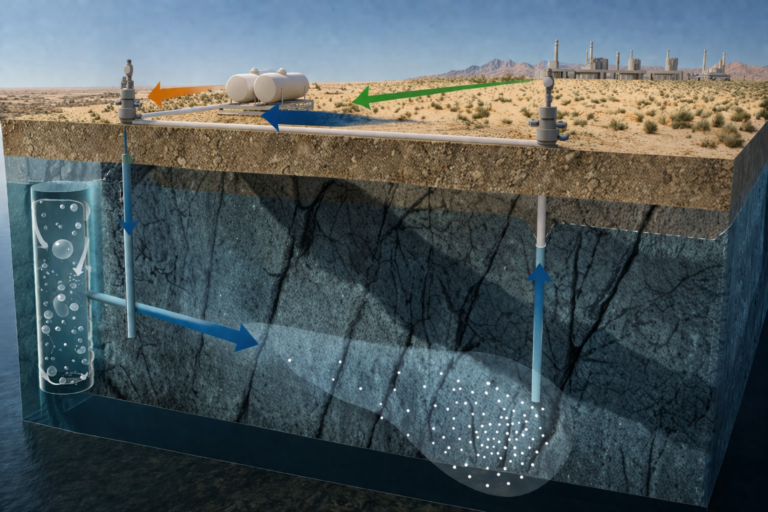
Carbon sequestration for arid regions overcomes water constraints
Earth Science and Engineering
Asymmetric surface deformations reveal ongoing processes after earthquakes
Earth Science and Engineering
When Earth breaks the “rules”

Earth Science and Engineering
Unearthing Arabia’s ancient foundations: New insights from the Ha’il terrane

Earth Science and Engineering
Sensing color cues to monitor coral health in the Red Sea
Earth Science and Engineering
Kahramanmaraş earthquake study showcases potential slip rate errors

Chemical Engineering