

Mechanical Engineering
Green hydrogen from fluctuating power sources
Controversial catalyst additive improves stability in direct green hydrogen production.


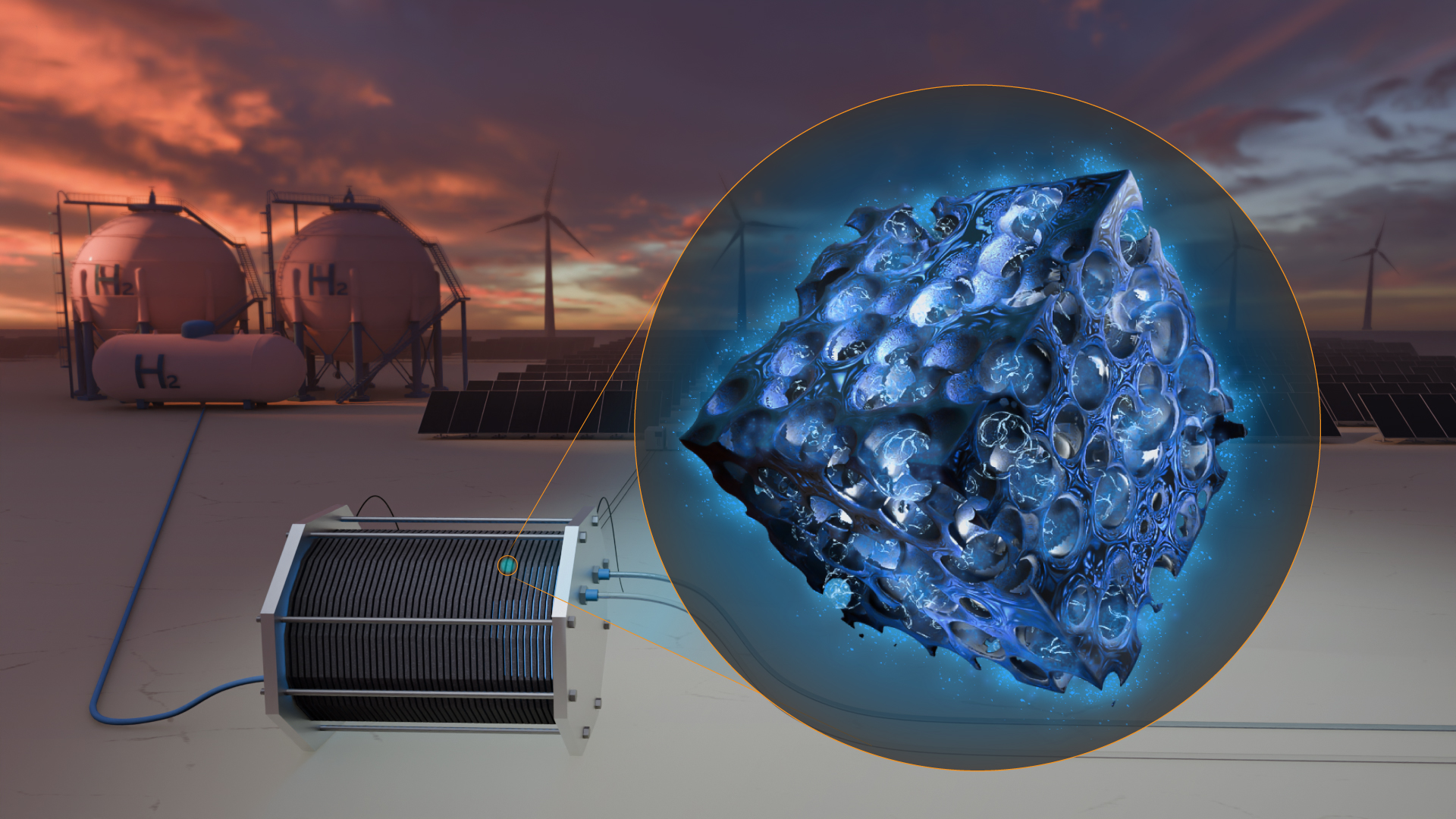
Energy systems can come under enormous strain from sudden changes in renewable generation, such as when sunlight rapidly increases as clouds pass, or when strong gusts hit a wind farm. A clean energy storage technology that handles these power peaks and troughs with ease, converting renewable electricity into green hydrogen, has been demonstrated by researchers at KAUST[1].
Storing renewable energy as clean hydrogen fuel is a critical element of future energy systems. Green hydrogen is made by using renewable electricity to split water molecules, using a device called an electrolyzer.
Today’s electrolyzers are poorly suited to this task. “Most water-splitting electrolyzers depend on steady electricity from the power grid — but that electricity often comes from fossil fuels, negating hydrogen’s environmental benefit,” says Abdul Malek, a postdoc in the lab of Xu Lu, who led the research.
One electrolyzer component highly vulnerable to sudden power surges is the water splitting catalyst. Low-cost nickel–iron (NiFe) catalysts work well when power supply is steady but can degrade rapidly when connected to renewable power sources that keep switching on and off, Malek explains. “Until now, there was no clear way to help such catalysts survive these harsh conditions for long periods,” he adds.
Some previous studies had suggested that adding chromium to NiFe catalysts might improve performance, but other reports concluded that the chromium-modified catalyst quickly broke down during operation. Lu and his team wondered if both findings might be true.
“We suspected that chromium might act like a temporary helper, guiding the catalyst into its most active and stable form when the system first starts running,” Malek says. “This idea was inspired by our earlier research, where we observed that chromium gradually washes out during operation — but instead of harming the catalyst, the process left behind a more porous structure that improved performance.”
The researchers tested the concept by designing a NiFe catalyst that incorporated a sacrificial quantity of chromium. They used a raft of analytical techniques, including X-ray photoelectron spectroscopy and inductively coupled plasma–optical emission spectroscopy, to track the catalyst’s changing composition and structure during use.
The results confirmed that the chromium gradually disappeared during electrolyzer operation, leaving behind an open structure of nickel and iron in a stable oxidized state.
A lab-scale electrolyzer fitted with the new catalyst maintained strong, stable performance over 30 days of fluctuating power. The researchers then teamed up with industry to test the catalyst at scale. “We demonstrated that an eight-cell electrolyzer stack, which delivered 2.5 kW peak power, remained stable over 13 simulated stop-start solar cycles,” Malek says. The device recovered instantly after a sudden power loss test, he adds.
“The challenge is to develop inexpensive electrolyzer systems that can operate stably for thousands of hours under real dynamic conditions,” Lu says. “Our next steps are larger stacks, direct coupling with solar power, and further improved earth-abundant catalysts and system engineering. The goal is practical, renewable-powered green hydrogen production that works outside the lab,” he concludes.
Reference
- Malek, A., Wu, L., Li, Y., Li,C., Chen, C., Hazazi, K., Xue, Y., Lu, X. Transient-promoter-stabilized NiFe Oxyhydroxide enables durable kW-scale water splitting under fluctuating power. Angewandte Chemie International Edition 65, e20825 (2026).| article.
ABOUT THE AUTHOR
Abdul Malek
Postdoc

You might also like

Mechanical Engineering
Gas detector flags early battery failure
Mechanical Engineering
Cracking clean fuel combustion

Mechanical Engineering
Tiny sensor could transform head injury detection

Mechanical Engineering
Electrocatalytic CO2 upcycling excels under pressure

Chemical Engineering
Rethinking machine learning for frontier science

Mechanical Engineering
Falling water forms beautiful fluted films

Mechanical Engineering
Innovative strain sensor design enables extreme sensitivity
Mechanical Engineering