

Mechanical Engineering
Electrocatalytic CO2 upcycling excels under pressure
A KAUST-designed reactor uses renewable electricity to convert captured carbon into high-value chemicals, making CO₂ reuse economically viable.


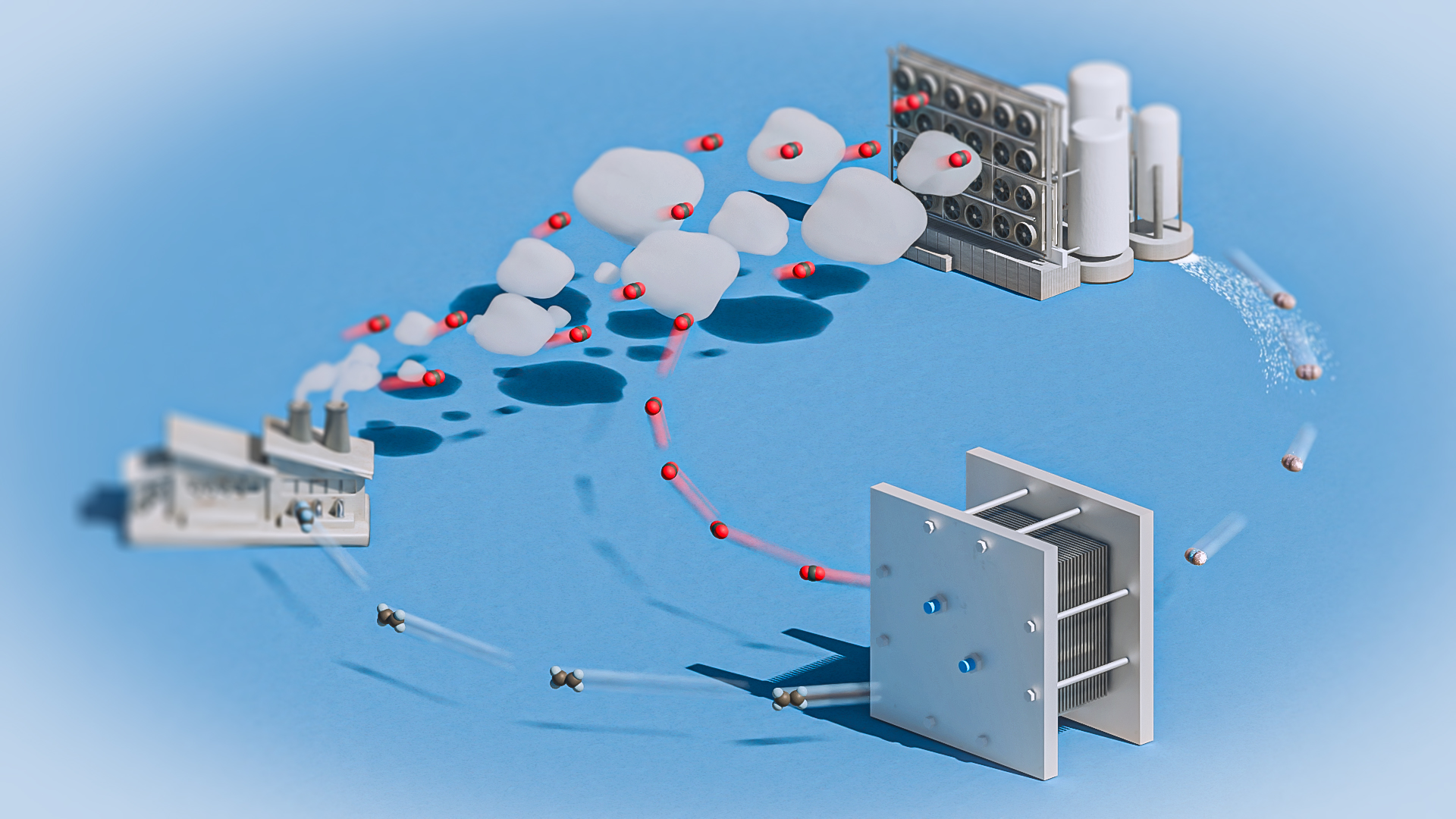
An electrocatalytic reactor that directly converts a high-pressure stream of captured CO2 into a major commodity chemical could offer an economically viable option for addressing climate change.
Conventional carbon capture prevents industrial CO2 emissions from reaching the atmosphere by trapping the greenhouse gas from factory or power plant emissions and pumping it underground for long-term geological storage. The high economic cost of this process prompted a KAUST team to consider an alternative approach. “We aimed to convert industrially captured high-pressure CO2 directly into valuable chemicals, which would turn carbon capture into an economic opportunity,” says Xu Lu, from the Chemical Engineering programme, who led the study.
The team devised an electrocatalytic reactor that directly connects to the latest cryogenic carbon capture system[1]. The reactor’s copper-based electrocatalyst turns the high-pressure, high-purity stream of captured CO2 into industrial-grade ethylene.
“This commodity chemical is essential to plastics, textiles, and construction, and has a global market that exceeds US$200 billion per year,” says Liang Huang, a member of Lu’s team.
Previous attempts to electrocatalytically convert captured CO2 into valuable chemicals, using reactors that run at ambient pressure, had limitations that prevented real-world use. These limitations have included sluggish reactivity; low reaction selectivity that then required additional steps to purify the products generated; and a buildup of salt byproducts in the reactor that choke its performance.
The new process involved operating the reactor under pressure, which significantly enhanced reactivity and selectivity for ethylene production, say the researchers. The high-pressure process had the dual benefit of significantly increasing CO2 coverage of the electrocatalyst as well as accelerating the C–C coupling reaction required for ethylene formation. “Also, by directly using the high-pressure captured CO2 gas stream, we avoid the energy loss of depressurizing and repressurizing the gas,” Lu explains.
The team further boosted their reactor system’s performance by systematically testing a series of copper electrocatalysts spiked with the atoms of other metals. They found that adding indium gave the best results. “Trace indium fine-tunes the adsorption of the key ‘*CO’ reaction intermediate onto the copper, promoting C–C coupling and improving product selectivity,” Lu says.
After recapturing unreacted CO2 from the product gas stream and cycling it back into the reactor’s high-pressure CO2 gas feed, the reactor system efficiently generated ethylene with 99.9% purity. “High-pressure operation boosted ethylene production performance,” Lu adds, “but it also helped to mitigate salt precipitation, which has been a long-standing challenge in the field.”
The team’s economic analysis showed that their new process can produce ethylene at a cost of US$1,240 per ton, a figure very close to ethylene’s current market price. “With system optimization, costs may fall further and turn carbon capture from a cost burden into a profit opportunity – as well as support Saudi Arabia’s ambition of becoming a circular economy by 2060,” Huang says.
“Overall, the study demonstrates that it is essential to co-design the catalyst and reactor system to realize practical CO2 upcycling,” Lu explains. “Next, we will scale up our single cell reactors into a modular reactor stack, extend operational lifetime, and run in-situ connected tests with capture facilities to move toward pilot demonstrations,” he adds.
Reference
- Huang, L., Gao, G., Zhao, J., Roberts, W.L. & Lu, X. Electrocatalytic upcycling of high-pressure captured CO2 to ethylene. Nature Catalysis 8, 968 (2025).| article.
ABOUT THE AUTHOR
Xu Lu
Assistant professor

You might also like
Mechanical Engineering
Gas detector flags early battery failure
Mechanical Engineering
Green hydrogen from fluctuating power sources
Mechanical Engineering
Cracking clean fuel combustion

Mechanical Engineering
Tiny sensor could transform head injury detection
Chemical Engineering
Rethinking machine learning for frontier science

Mechanical Engineering
Falling water forms beautiful fluted films

Mechanical Engineering
Innovative strain sensor design enables extreme sensitivity
Mechanical Engineering