

Mechanical Engineering
Falling water forms beautiful fluted films
Studying the physics behind this fleeting fluid phenomenon could improve various industrial processes.



“At first glance, water draining from a tube seems like an everyday process driven by gravity,” says Abhijit Kushwaha, a member of the team behind the work. “It is only with high-speed imaging that we can slow down time enough to capture the hidden choreography of this process.”
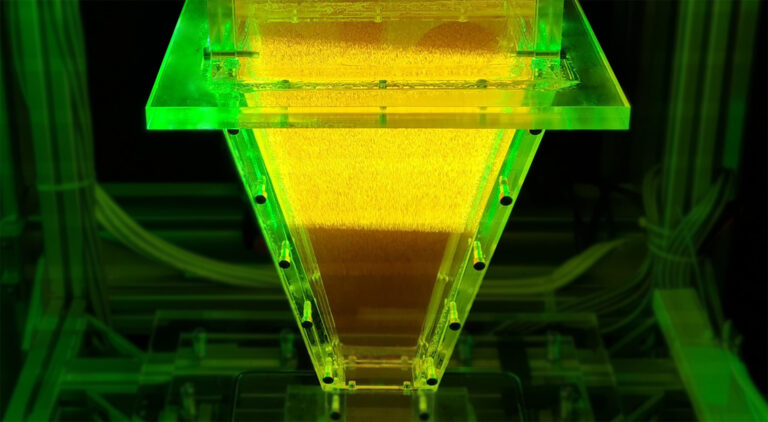
This revealed a curious effect for certain combinations of tube diameter and water height. As the liquid fell, a thin film of water dragged against the tube walls and descended more slowly. Once the main water column exited the tube, this film emerged and formed a fleeting, tulip-shaped bubble. In some cases, the fluted film quickly retracted into the tube; in others, it stretched until the water column broke away from it.
For example, devices called falling-film evaporators are widely used in industries like food processing, pharmaceuticals, and power generation to concentrate liquids or remove solvents. These systems feature thin films of liquid that evaporate as they flow down the walls of heated tubes. If these films break or become uneven, heat transfer efficiency can be reduced, or equipment can be damaged.
Reference
- Kushwaha, A. K., Jones, M. B., Belden, J., Speirs, N. & Truscott, T. T. Transient fluted films behind falling water columns. Phys. Rev. Lett. 134, 224001 (2025). | article
ABOUT THE AUTHOR
Abhijit Kushwaha
Postdoc

You might also like

Mechanical Engineering
Gas detector flags early battery failure
Mechanical Engineering
Green hydrogen from fluctuating power sources
Mechanical Engineering
Cracking clean fuel combustion

Mechanical Engineering
Tiny sensor could transform head injury detection
Mechanical Engineering
Electrocatalytic CO2 upcycling excels under pressure
Chemical Engineering
Rethinking machine learning for frontier science

Mechanical Engineering
Innovative strain sensor design enables extreme sensitivity
Mechanical Engineering