

Mechanical Engineering
Cracking clean fuel combustion
Advanced computer modeling reveals the complex combustion behavior of ammonia, a promising clean-burning carbon-free fuel, potentially accelerating its role in renewable energy systems.


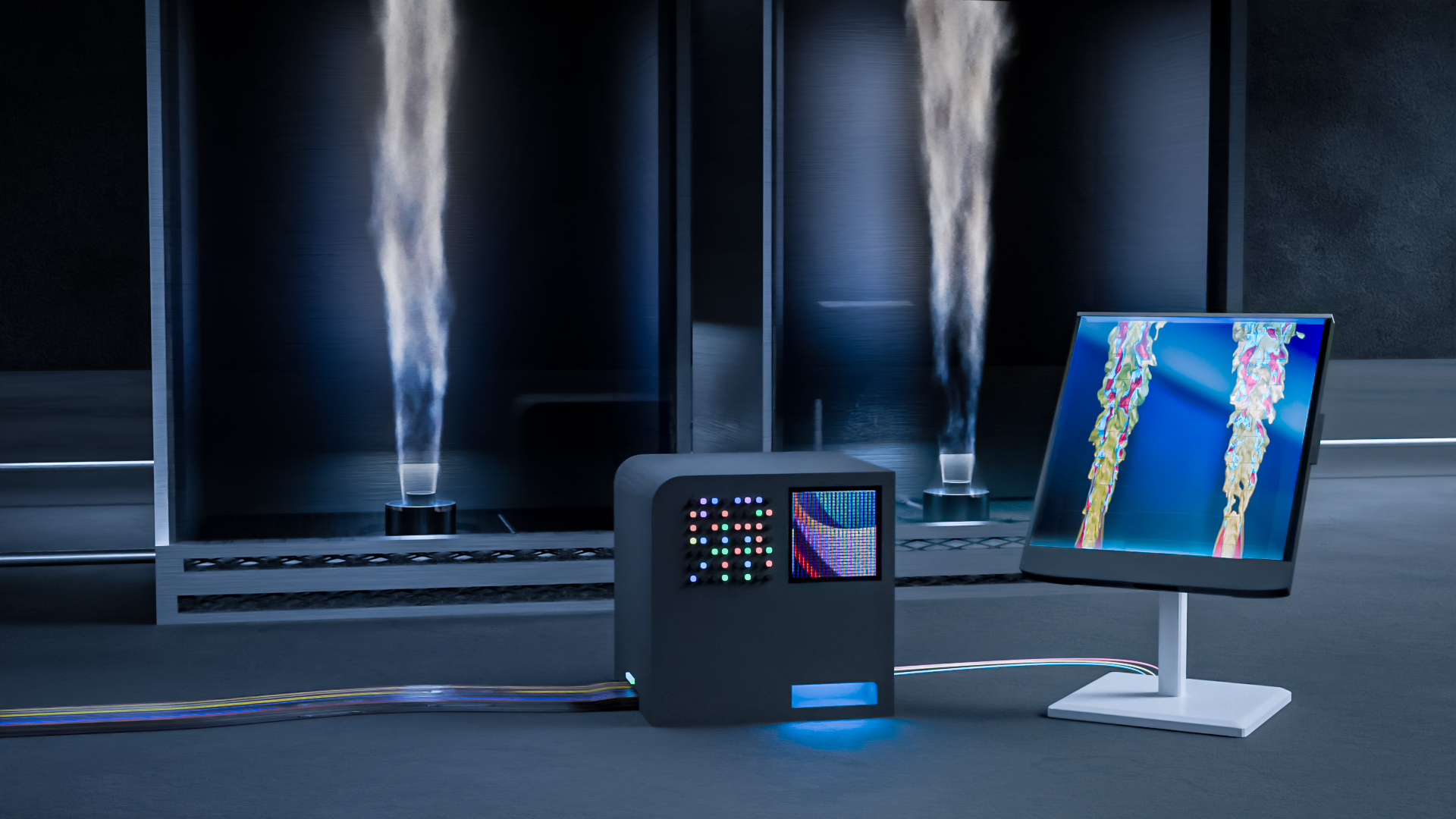
Wind and solar energy promise to make the electricity grid greener by delivering renewable energy at scale. But to smooth out seasonal renewable energy fluctuations and decarbonize parts of the global energy and transport system that are difficult or impossible to electrify, we will need clean-burning, carbon-free fuels produced from renewable sources.
Ammonia (NH3) is a carbon-free molecule that can serve directly as a fuel, can be produced renewably at scale, and can be stored and transported easily. However, in its pure form, ammonia has a low burn rate and is difficult to ignite. To address this, ammonia can be ‘cracked’ — heated to high temperatures over a catalyst — to partially break it down into a mixture of ammonia, hydrogen, and nitrogen, which increases the fuel’s reactivity and improves flame stability.
“Partially cracked ammonia is a realistic and promising fuel for future clean power and propulsion systems,” says Suliman Abdelwahid, postdoctoral researcher in Hong Im’s lab. “Understanding its combustion behavior under realistic conditions is essential for its safe and efficient deployment.”
The components of partially cracked ammonia have widely varying physical and combustion properties. The fuel burns in complex, turbulent flows that can produce toxic emissions of unburnt ammonia and NOx. “Using high-fidelity computer simulations, we aim to identify optimal combustion configurations and conditions to ensure complete combustion of ammonia with minimal NOx emissions,” Im says.
Laboratory experiments can provide essential data about the fuel’s characteristics, but they are expensive to run and reveal little about the inner structure of a turbulent flame. “Computational modeling can provide critical information that enables researchers to study flame behavior in detail, safely testing operating conditions on a computer,” says Junjun Guo, a research scientist on the team. “Once these models are validated against experiments, they can help engineers to design complex combustion systems that optimize performance, while reducing the need for costly physical testing,” he adds.
Fully modeling the complex chemistry of partially cracked ammonia combustion is computationally prohibitive, making it a major challenge to simulate the process efficiently and accurately. “So, instead of trying to track dozens of chemicals, we focused on a few key variables that capture the main behavior of the flame,” Abdelwahid says.
The team used AI to assist with the task[1]. “We trained neural networks on high-quality flame data, to accurately reconstruct temperature and species mass fractions,” Guo says. “The model accounts for differences in how fuel molecules move and mix.”
Whereas detailed chemistry simulations might have taken a month to complete, the team’s model produced results in about half a day, achieving a major efficiency gain without sacrificing accuracy. “By reliably predicting flame structure, mixing, stability, and extinction, our model will help designers to optimize burners and operating conditions, supporting the development of safer, cleaner, and more efficient ammonia-based combustion technologies,” Abdelwahid explains.
Combining their advanced model’s output with a few key physical experiments, the team aims to collect enough data to build a virtual ‘digital twin’ combustion system, from which they can design and optimize a real-world system for partially cracked ammonia combustion.
Reference
- Abdelwahid, S., Malik, M. R., Guo, J., Tang, H., Hernández–Pérez, F. E., Magnottic, G., Im, H. G. Modeling local extinction and differential diffusion in KAUST ammonia flames D and F using principal component transport. Applications in Energy and Combustion Science 24, 100424 (2025).| article.
ABOUT THE AUTHOR
Suliman Abdelwahid & Junjun Guo
Postdoc & Research scientist

You might also like

Mechanical Engineering
Gas detector flags early battery failure
Mechanical Engineering
Green hydrogen from fluctuating power sources

Mechanical Engineering
Tiny sensor could transform head injury detection

Mechanical Engineering
Electrocatalytic CO2 upcycling excels under pressure
Chemical Engineering
Rethinking machine learning for frontier science

Mechanical Engineering
Falling water forms beautiful fluted films

Mechanical Engineering
Innovative strain sensor design enables extreme sensitivity
Mechanical Engineering