

Environmental Science and Engineering
Ultrathin water repellent membrane advances desalination
An ultrathin membrane enables energy-efficient freshwater production from seawater and brines at ambient temperature and pressure.


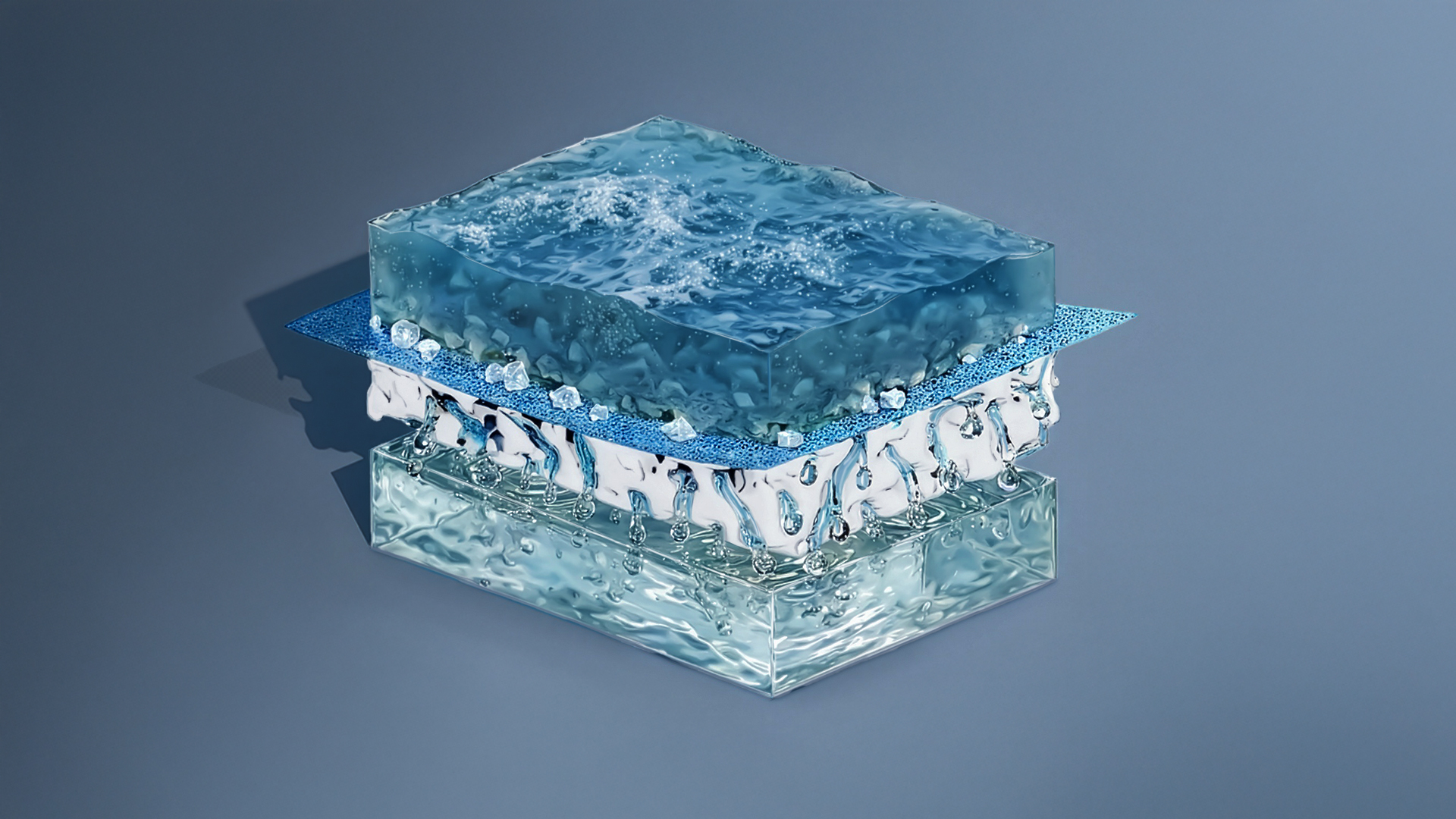
Technologies capable of generating freshwater efficiently and cost-effectively are critical for reaching sustainability goals, particularly in arid regions such as the Middle East. Researchers have now developed a polymeric membrane that can desalinate seawater and brines at ambient temperature and pressure[1]. The work was carried out by an international research team led by scientists at King Abdullah University of Science and Technology (KAUST).
“Water scarcity is severe in Saudi Arabia and is reaching unprecedented levels in countries once thought to be safe from such pressures,” says Noreddine Ghaffour, who led the research. “We urgently need to produce freshwater from seawater and brines at any scale, efficiently and cost-effectively, while conserving energy.”
Conventional membrane-based technologies such as reverse osmosis are most cost-effective at very large scales and depend on sophisticated energy-recovery systems. Even under these conditions, treating highly concentrated brines remains difficult because of the extreme pressures required. Membrane distillation offers an alternative approach, but it typically relies on elevated temperatures to vaporize water before it passes through a membrane and condenses as freshwater.
The membrane developed by Ghaffour’s team consists of an ultrathin polymeric film supported by a porous substrate and is designed for membrane distillation at low temperatures. The film contains sub-nanometer-sized pores and has a highly water-repellent, or superhydrophobic, surface, allowing the process to operate under ambient pressure.
In the system, warm saline water at approximately 25 ºC flows along one side of the membrane, while cooler water at 20 ºC flows along the other. This small temperature difference creates a natural driving force that pulls only water vapor across the membrane, where it condenses as pure water, leaving salt and other contaminants behind.
“What distinguishes our membrane is its ultrathin separating layer, only a fraction of a micrometer thick, combined with a highly water-repellent surface,” says project team member, Mohamed Obaid Awad. “This superhydrophobicity is crucial because it prevents liquid seawater from entering and flooding the membrane pores.”
At the nanoscale, the membrane remains ‘air-filled’, ensuring that only water vapor can pass through. Water does not need to boil to evaporate; even at room temperature some water molecules naturally escape into the vapor phase. Here, the extremely small pores enhance this effect by increasing local vapor pressure, facilitating evaporation.
The membrane also demonstrates high rejection of salt and acts as a total barrier to boron and other contaminations, preventing dissolved ions from entering the vapor pathway and improving performance in realistic desalination conditions.
“Salt ions and other dissolved species cannot evaporate under these conditions and are therefore excluded,” says Sofiane Soukane, a member of the research team. “Also, the membrane material is resistant to chlorine-based oxidants, which improves durability and long-term stability.”
Moving beyond the laboratory, the team is currently testing the technology in a pilot plant at KAUST. “Lessons from the pilot study will guide how we scale up membrane production,” says Ghaffour. “We have several industrial partners keen to get involved.”
Reference
- Obaid, M., Soukane, S., Qtaishat, M.R., Zhang, Y., Guillerm, V., Mohamed, H.O., Ayach, M., Singaravelu, V., Castaño, P., Maurin, G., Eddaoudi, M., Matsuura, T., & Ghaffour, N. Subnanoporous hydrophobic thin films for ultrahigh-efficiency seawater brines desalination using membrane distillation. Nature Communications (2026).| article.
ABOUT THE AUTHOR
Mohamed Obaid Awad & Sofiane Soukane
Research scientists

You might also like
Environmental Science and Engineering
Soil biodiversity is an overlooked frontline of disease prevention
Environmental Science and Engineering
Soil microbes are source of plastic-degrading enzymes
Environmental Science and Engineering
Bringing together the tools to harness the potential of microbial diversity
Environmental Science and Engineering
Climate action needs a tree change

Chemical Engineering
Natural solvents enable fully bio-based membranes

Environmental Science and Engineering
Plant diversity reduces the impacts of grazing pressure in drylands
Environmental Science and Engineering
Water-repelling surfaces reveal surprising charging effects
Environmental Science and Engineering