

Applied Mathematics and Computational Sciences
Resilient renewable energy networks designed for the desert
Accounting for weather extremes is essential for designing reliable renewable energy systems in hot, arid regions.


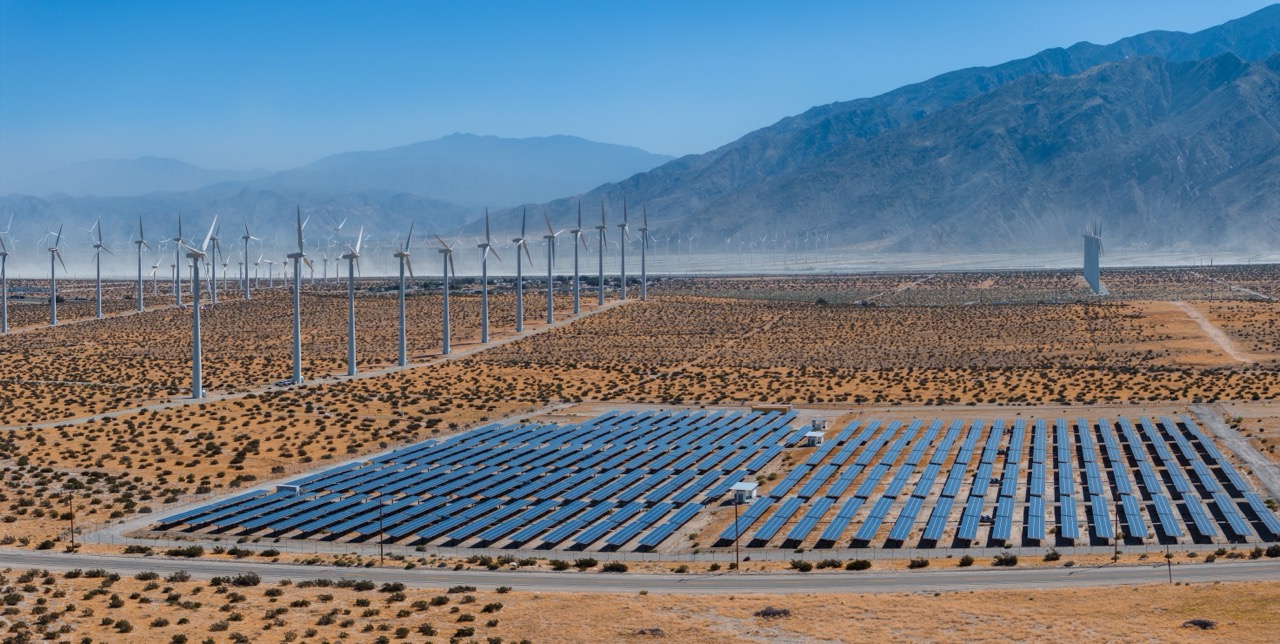
Reliable electricity supply is vital in desert locations, where maintaining cooling systems during heatwaves can be essential for human health. For communities considering a shift to renewable energy, accounting for extreme weather events can help prevent electricity shortfalls, KAUST researchers have shown[1].
Recent advances in renewable energy generation and storage are leading many sustainability-focused communities, including the KAUST campus, to explore how they might transition from fossil-fueled electricity to local grids powered entirely by renewable energy. “These systems must be carefully designed to ensure reliability,” says Farah Souayfane, a research scientist in Omar Knio’s lab, who led the work.
“Most existing designs for community-scale renewable energy systems in hot desert regions like Saudi Arabia optimize performance for average weather conditions,” Souayfane explains. “This approach could lead to failures during rare but critical weather events,” she adds.
Extreme weather days — characterized by very hot, calm, and cloudy conditions — combine high electricity demand for cooling with low electricity supply from wind and solar. This mismatch wouldcan result in power failures in systems not designed for such conditions.
“We sought to explicitly account for extreme weather in renewable energy systems designed for hot desert communities and quantify the cost implications by designing a resilient renewable energy system for KAUST,” says Ricardo Lima, a research scientist in Knio’s group.
The team based their analysis on a 25-year historical record of hourly weather data for KAUST’s location. “The system was first optimized for a single year of data, then simulated over the full 25-year period to identify failure events when supply did not meet demand,” Souayfane says. These extreme conditions were progressively incorporated into the design, with additional electricity storage and generation capacity added until the system could reliably meet energy demand.
“The system balances cost and resilience by combining concentrated solar power, photovoltaic panels and wind turbines with battery and thermal storage,” Lima says. “Resilience was further improved by using the KAUST desalination plant’s flexible energy demand to reduce stress on the system during extreme events.”
The team found that the optimized system could reliably meet KAUST’s electricity demand during historical extreme conditions while avoiding more than 330,000 tonnes of CO₂ emissions annually compared with fossil fuel electricity supply. “Achieving this level of reliability requires additional investment, increasing system costs by 19 to 30 percent depending on configuration,” Lima notes.
The analysis provides KAUST with a practical framework for designing a resilient, low-carbon power system suited to campus-scale applications, Knio says. He adds that for Saudi Arabia, it offers insights into how renewable energy systems can support energy diversification and emissions reduction under harsh climatic conditions.
Next, the team is exploring additional demand-side flexibility options to manage energy usage during extreme events, including district cooling operation and storage flexibility. The researchers are also integrating climate projections to account for future risks as well as historical extremes. “This will support long-term planning and improve resilience metrics for renewable energy systems,” Knio says.
Reference
- Souayfane, F., Lima, R.M., Katoua, A. & Knio, O. Integrating weather extremes and desalination flexibility to design a resilient concentrated solar power–photovoltaic–wind system with battery and thermal storage using TRNSYS. Energy Conversion and Management 351, 121064 (2026).| article
You might also like
Applied Mathematics and Computational Sciences
Smarter MRI image analysis for the whole heart
Applied Mathematics and Computational Sciences
Realistic scenario planning for solar power

Applied Mathematics and Computational Sciences
Bringing an old proof to modern problems
Applied Mathematics and Computational Sciences
Accounting for extreme weather to boost energy system reliability
Applied Mathematics and Computational Sciences
Past and future drought patterns across the Arabian Peninsula
Applied Mathematics and Computational Sciences
New pattern for underwater resonators

Applied Mathematics and Computational Sciences
Finer forecasting to improve public health planning

Applied Mathematics and Computational Sciences