

Applied Mathematics and Computational Sciences
Smarter MRI image analysis for the whole heart
A Bayesian approach that selects the most informative frames for manual labeling could speed up real-time heart MRI analysis.


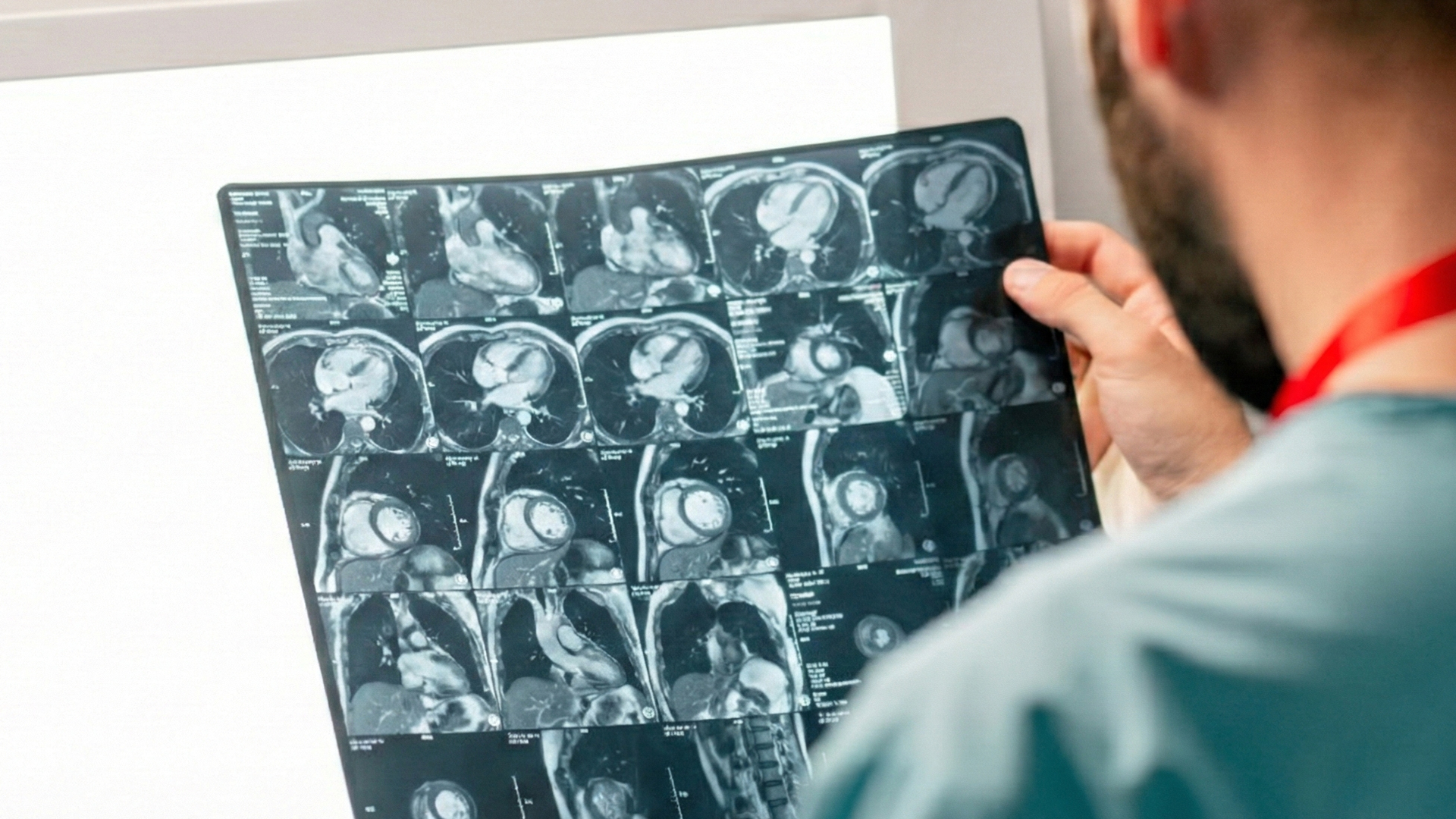
Cardiovascular diseases remain a leading cause of death worldwide. Every year thousands of children are born with congenital heart disease. Reliable, efficient tools that can accurately assess heart function are critical for heart disease diagnosis and treatments.
Now, a novel machine learning method of analyzing real-time cardiac magnetic resonance imaging (MRI) scans has been developed by KAUST researcher Raúl Tempone in collaboration with scientists at the German Aerospace Center, in Cologne[1].
“Cardiac real-time MRI is an invaluable method of scanning the heart, and can acquire up to 50 frames per second, which is excellent in clinical terms,” says Tempone. “However, this generates thousands of images that are near-impossible to process manually.”
A typical short scan at 30 frames per second for 10 seconds can produce around 4,500 images to annotate across 15 ‘slices’, or cross-sectional images through the heart. Neural networks can accurately segment most of these images, but fail to consistently segment the ventricular cavity in the outer slices at the base and apex of the heart. This means that the ventricular volume — the amount of blood inside the heart’s ventricles throughout the cardiac cycle — in the outer slices is not always estimated reliably by the neural networks.
In the workflow, a clinician must perform a visual quality check to separate reliably segmented inner slices from the unreliable outer slices. This is particularly important for patients with rare heart diseases and unusual anatomy, such as univentricular hearts.
“We wanted to find a way to attain trustworthy estimates of ventricular volume across the entire heart, and analyze the most pertinent images accurately,” says Tempone. Ventricular volume is a critical measurement in the assessment of cardiac diseases, but it changes continuously in complex ways depending on the patient’s breathing and heartbeat.
“The volume of a heart ventricle over time is not arbitrary: it is dominated by a small number of frequencies, primarily associated with the heart rate and breathing pattern,” says Tempone. “Our modeling framework uses sparse Bayesian learning (SBL) to identify the most relevant frequencies for each patient.”
Their model learns a patient-specific ‘frequency fingerprint’ from ventricular volume curves extracted from the reliably segmented inner slices. Those dominant frequencies correspond primarily to the heart rhythm and breathing. The SBL model identifies which frequencies really matter, and automatically prunes irrelevant frequency components during training. The model then selects the most informative frames (time points) for manual labeling on the unreliable outer slices, to reduce uncertainty.
“With a few carefully chosen manual labels, we can reconstruct accurate ventricular volume curves across the entire heart,” says Tempone. “Crucially, we can also quantify uncertainty: in other words, our model clearly states when automated measurements can, and can’t, be trusted.”
In tests on real-time MRI data from two patients with univentricular hearts, the approach required only a few manually labeled images to accurately predict ventricular volume on the challenging outer slices.
“Our model-based labeling strategy is generic and can be integrated into other cardiac MRI workflows,” concludes Tempone. “The model could easily be transferred into other medical image analysis pipelines that have similar data and label scarcity issues.”
Reference
- Bach, A., Basermann, A., Gerlach, D., Knechtges, P., Tank, J., Tempone, R. & Terhag, F. Sparse Bayesian learning for label efficiency in cardiac real-time MRI. Statistics and Computing 36, 21 (2026).| article.
ABOUT THE AUTHOR
Raúl Tempone
Professor

You might also like

Applied Mathematics and Computational Sciences
Resilient renewable energy networks designed for the desert

Applied Mathematics and Computational Sciences
Realistic scenario planning for solar power

Applied Mathematics and Computational Sciences
Bringing an old proof to modern problems

Applied Mathematics and Computational Sciences
Accounting for extreme weather to boost energy system reliability
Applied Mathematics and Computational Sciences
Past and future drought patterns across the Arabian Peninsula

Applied Mathematics and Computational Sciences
New pattern for underwater resonators

Applied Mathematics and Computational Sciences
Finer forecasting to improve public health planning

Applied Mathematics and Computational Sciences