

Chemical Engineering
Fluoride treatment gives catalyst extra bite
A surprising discovery about fluoride treatment could inspire new ways to improve industrial catalyst performance.


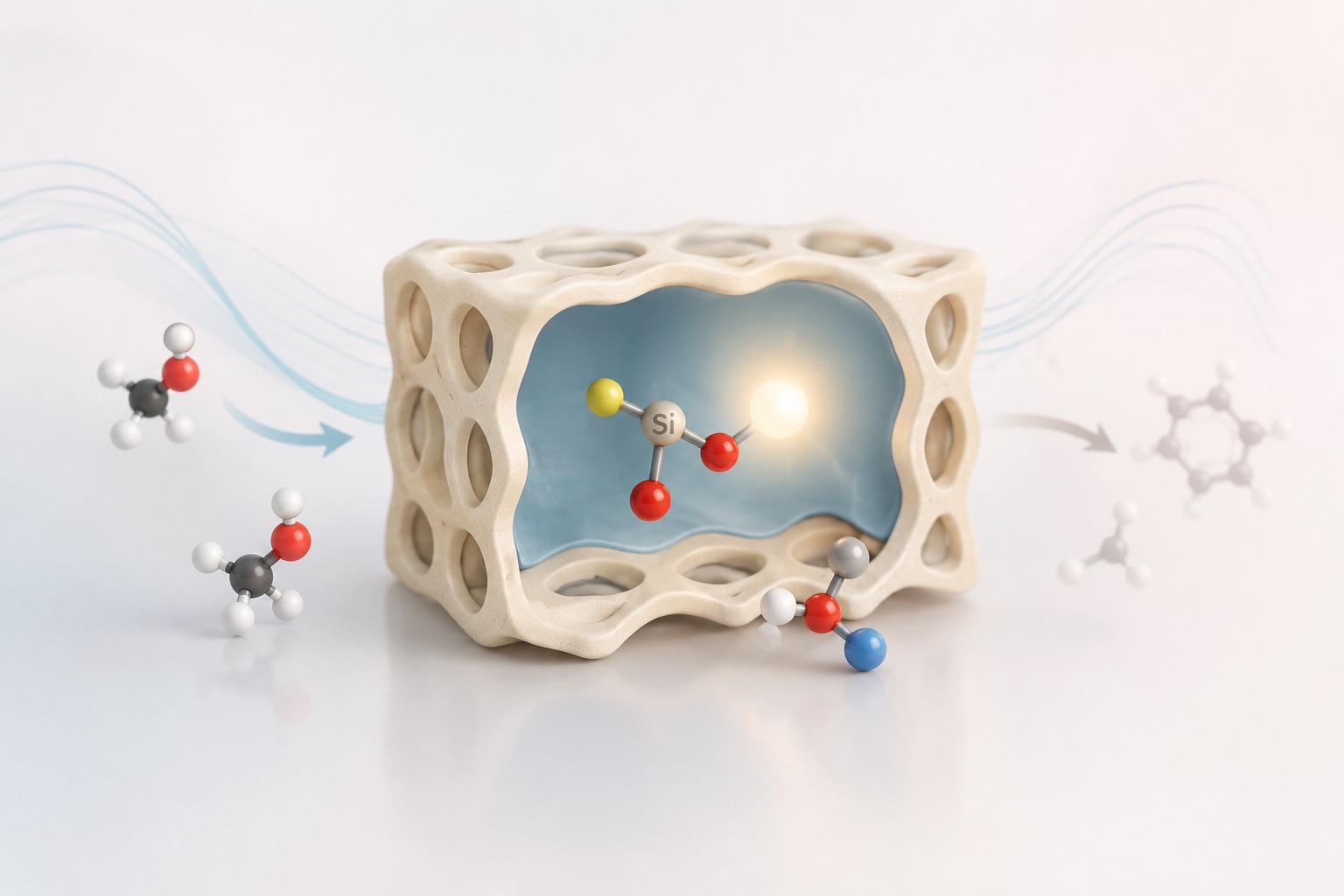
An old trick for boosting the reactivity and selectivity of zeolite catalysts could be far more useful than previously thought. KAUST researchers have shown that fluoride-based treatment has a far more profound impact on the catalyst’s structure and activity than suggested by earlier studies[1]. The discovery could unlock new pathways to enhanced industrial catalysis.
Zeolites are among the most important catalysts used in industry, says Lu Song, a member of Javier Ruiz-Martínez’s research group. These acidic porous solids, made of aluminum, silicon, oxygen, and hydrogen, play a central role in petroleum refining, petrochemical manufacturing and many large-scale chemical processes.
“Zeolites’ exceptional catalytic performance arises from their unique combination of well-defined acidic sites and highly ordered microporous structures, which enable precise control over chemical reactions,” explains Song.
Washing the zeolite with fluoride is an established method for tuning the catalyst’s acidity and reactivity. The treatment was believed to work by stripping some of the aluminum from the structure, says Ruiz-Martínez. “However, we suspected that this could not be the whole story,” he adds.
Fluorine is the most electronegative element in the periodic table, strongly attracting electrons from nearby atoms. “When fluorine remains within the zeolite framework, bonded to silicon or aluminum, it could strongly polarize the surrounding chemical environment, influencing the strength and properties of nearby acidic sites,” says Ruiz-Martínez.
The team designed three experiments to test whether fluorine atoms left within the zeolite structure after treatment really were as chemically inactive as previously believed. In the first experiment, the researchers measured the acidity of the treated zeolite and found that its enhanced acidity could not be explained by dealumination alone.
The researchers then used advanced forms of an analytical technique called solid-state nuclear magnetic resonance (NMR) to directly observe any fluorine species remaining in the zeolite. “The NMR analysis showed that fluorine remained in the zeolite after treatment, as distinct fluorine species associated with framework silicon and aluminum,” says Song. Solid-state NMR also revealed the much richer and more polarized environment around the fluoride-treated zeolite’s acidic sites, providing a molecular-level explanation for the enhanced acidity observed.
The final piece of evidence came when the team applied the fluoride treatment to a zeolite-related material called silicalite-1, which contains no aluminum. “Fluoride treatment of silicalite-1 also generated enhanced acidity, demonstrating that fluorine itself can directly reshape zeolitic acidity even in the absence of framework aluminum,” Song says.
The results show that fluorine should no longer be viewed simply as a dealuminating reagent, but as an active zeolitic acidity modifier. “This discovery introduces a new strategy for catalyst design by tuning acidity beyond conventional approaches such as changing the Si/Al ratio or introducing structural defects,” explains Song.
The treated zeolite showed enhanced aromatic selectivity and prolonged lifetime when tested as a catalyst for the methanol-to-hydrocarbons reaction, an important petrochemical manufacturing process.
“Our future work will include exploring the application of these modified materials in other zeolite-catalyzed reactions,” says Ruiz-Martínez. “Our discovery that fluorination alters the acidity of the zeolite may unlock enhanced reactivity and selectivity in a broad range of industrially relevant zeolite-catalyzed processes.”
Reference
- Song, L., Morlanés, N., Abou−Hamad, E., Ruiz-Martínez, J. Beyond dealumination: does fluorine reshape zeolitic acidity?. Journal of the American Chemical Society advance online publication, June 11, 2026.| article.
You might also like

Chemical Engineering
Engineered membranes made from corn proteins

Chemical Engineering
Clean jet fuel chemistry takes flight

Chemical Engineering
Natural solvents enable fully bio-based membranes

Chemical Engineering
Urban air pollution goes up in smoke

Chemical Engineering
Rethinking machine learning for frontier science

Chemical Engineering
Magnetic nanoparticles capture microplastics from water
Chemical Engineering
Biogas upgrading goes with a swing

Chemical Engineering